
ACT NOW! Take control of your finances and get up to $1,050.* Book your call today.


Are dividend stocks a good investment? Understanding the risks

The short answer:

Focusing purely on dividend stocks can be dangerous because high-dividend companies have historically underperformed the broad market over time. They don’t provide reliable downside protection and capture significantly less upside when the market rallies, which can hurt your long-term roadmap. For true investment success, don’t view a company’s dividend rate as a unique characteristic or a substitute for total return.

Step of money coins stacks

Jump to a section:

Key takeaways:

  1. Dividend-paying stocks have underperformed other types of stocks
  2. Dividend stocks do not necessarily protect a portfolio on the downside
  3. The average high-dividend stock is less profitable, growing slower, and has more debt than the average company
  4. Targeting high-dividend stocks may result in a portfolio of highly leveraged, slow-growing companies
  5. Investors should not view dividend rate as a unique characteristic and should aim for both income and appreciation

“The true investor will do better if he forgets about the stock market and pays attention to his dividend returns and to the operation results of his companies.” - Benjamin Graham

Graham’s sentiment in this quote is shared by many investors even today. Returns from dividends can feel more real and sustainable than stock price appreciation. After all, a dividend is cash in your pocket.

Moreover, it seems intuitive that dividend-paying companies must be more established and stable to afford to pay out consistently.

Unfortunately, the reality is more complicated than this. It turns out that dividend-paying stocks are not more stable, predictable, or better performing than other kinds of stocks.

In fact, focusing on income over price appreciation can be dangerous for your portfolio.

Here’s why.

Dividend stocks have underperformed other kinds of stocks

The first simple reality is that high-dividend stocks have performed worse than the broad market over time.

The chart below compares the S&P High Dividend index, which consists of the 80 highest dividend-yielding stocks within the S&P 500, and compares that to the whole S&P 500.
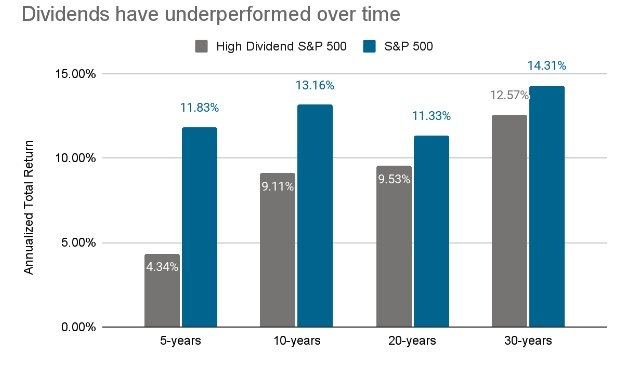
High dividend S&P 500 performance 30 years

Source: S&P Dow Jones Indices. Data as of 5/26/2023

Dividend stocks don’t protect your portfolio on the downside

You may have heard a claim that dividend stocks are safer or more stable than other kinds of stocks.

For example, in calendar 2022, the S&P High Dividend index was only down 1.1% vs. -18.1% for the whole S&P 500. However, this kind of downside protection has not been consistent over time.

To test this, we ran an analysis called “upside and downside capture.” This test measures what percentage of the upside or downside return an asset realizes in any given period.

Here’s the result.
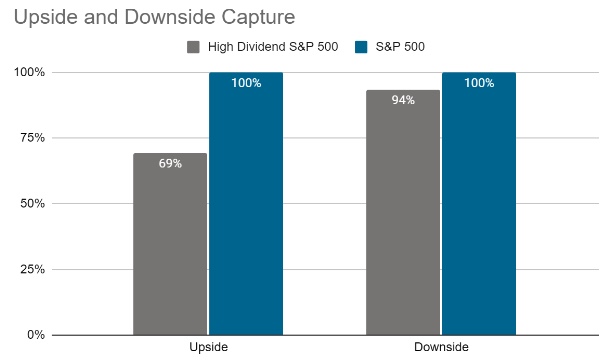
Upside/downside capture

Source: S&P Dow Jones Indices and Facet calculations

These percentages mean that we expect dividend stocks to suffer 94% of the downside when the S&P falls but capture only 69% of the upside.

Put another way, if the S&P rises by 10%, this analysis suggests dividend stocks would tend to only rise by 6.9%. Whereas if the S&P falls by 10%, the dividend stocks would barely offer any protection, falling by 9.4%.

When running this capture analysis, we generally want to see the upside percentage higher than the downside percentage. This is especially true given that stocks typically rise more often than they fall.

Remember that the S&P 500 has increased in 16 of the last 20 years. You can’t afford to give up this much upside only to get a slight amount of downside protection.

Why have dividend stocks performed so poorly?

The average high-dividend stock is fundamentally different from its lower-dividend peers. These differences probably explain why they have underperformed historically and could portend underperformance looking forward.

First, let’s look at this statistically. The following table shows the average of key financial metrics for the S&P 500 and the high-dividend index.

S&P High Dividend S&P 500
Profit margin¹ 4.86% 10.10%
Leverage ratio² 6.6 3.1
Sales growth³ 4.36% 9.85%
Return on equity⁴ 16.59% 48.92%

Source: Bloomberg, company reports

This table shows that the average high-dividend stock is less profitable, growing slower, and has more debt than the average company overall.

This isn’t a coincidence. Companies that pay high dividends tend to have no other good use for that capital. In contrast, companies still in growth mode tend to want to reinvest in their business.

Moreover, companies that aren’t growing commonly use debt to generate shareholder returns. This includes making acquisitions or borrowing money to fund dividend payments hence why our universe of high dividend-paying companies has a higher leverage ratio than other companies.

Should we own high-dividend companies at all?

We’re not saying investors should avoid these companies at all costs. Rather, it’s best not to view the company’s dividend rate as a unique characteristic.

Targeting a set of high-dividend stocks will result in a portfolio of highly leveraged, slow-growing companies. As a result, we do not believe this approach will lead to investment success.

We started this piece with a quote from Benjamin Graham which seemed to praise dividends. But perhaps this Graham quote sums it up better:

“The stockholder wants both income and appreciation, but in general the more he gets of one the less he realizes of the other.”

Ready to get more organized and have more clarity with your money? Schedule a free call with Facet. We’ll show you how a personalized financial roadmap, built for you by a CFP® professional, can turn your money into a tool to help you live a better life today, and feel more confident about tomorrow.

FAQs

No, they don’t offer consistent downside protection over time. According to an upside and downside capture analysis, dividend stocks are expected to suffer 94% of the downside when the S&P 500 falls, but they only capture 69% of the upside when the market rises.

High-dividend companies are fundamentally different from their lower-dividend peers because they’re typically less profitable, grow slower, and carry more debt. Companies that pay high dividends often lack good ways to reinvest in their business, and they commonly use debt to fund dividend payments or generate shareholder returns.

We’re not saying you should avoid them at all costs, but it’s best not to view a dividend rate as a unique characteristic. Targeting only high-dividend stocks leaves you with a portfolio of highly leveraged, slow-growing companies, which isn’t an approach that leads to long-term success on your financial journey.

About Facet

Facet is a national, SEC-registered investment advisor (RIA) and consumer fintech leader dedicated to making expert financial planning accessible to everyone.

Through a transparent, flat-fee membership model, Facet provides objective guidance designed to put the member’s best interest first—always. Unlike traditional firms that often take a cut of your returns or charge by the hour, Facet’s affordable fee doesn’t change even as your money grows, helping you keep more of your own money for the life you want to live.

Facet combines user-friendly technology with a dedicated team of CERTIFIED FINANCIAL PLANNER® professionals to deliver a personalized roadmap for every aspect of a member’s financial life. This comprehensive approach covers everything from the big milestones to everyday decisions—including investment management, tax strategy, equity compensation, and estate planning—evolving as your life and opportunities unfold. Facet’s mission is to empower individuals to move beyond “standard” advice, helping them make confident decisions and live more enriched lives through financial planning the way it should be: simple, guided, and all about you.

Explore more articles

Woman using laptop at home

How do I perform an insurance review?

We all want to feel secure knowing that the people and things we love most are protected. Life moves incredibly fast, and the safety net you put in place a few years ago might not match the life you are building today. Taking a little time to align your protection with your current world brings ... Read more

4 Min Read
Two diverse colleagues traders talking to each other, looking at graphs while sitting in the office in front of multiple computer screens.

Why picking individual stocks usually underperforms the market

A vast body of data suggests that picking winners in the stock market is extremely hard. Academic research in the 1960’s and 1970’s first provided some evidence that most active portfolio managers fail to outperform the broad market. This led to the popularization of index funds during the 1980’s and 1990’s, which continues today. However, ... Read more

5 Min Read
Couple reviewing tax documents at home

Why did I get Form 5498 after filing my taxes?

If you just opened your mail to find Form 5498, don’t panic. Your heart might skip a beat thinking you’ve missed a deadline or made a mistake on your recently filed tax return, but breathe easy. This form is for your records and typically arrives well after the April filing deadline for a very specific ... Read more

3 Min Read

Get started

To schedule a free consultation with a Facet expert, fill out the form below and we will contact you within 24 hours.

This field is for validation purposes and should be left unchanged.
This field is hidden when viewing the form

By submitting this form, you acknowledge that you have directly provided the email and phone number contact information listed, further acknowledge that Facet Wealth has the option to use either method to contact you, and agree to the terms set forth in our Company Privacy Notice. Message frequency varies, and message and data rates may apply. Reply STOP to opt-out of messages, and email [email protected] for help

OR
To speak with someone now, call us at
1-888-826-6401