
The U.S. bond market faces a number of challenges for the remainder of 2026 and into 2027, which is leaving some investors in bonds worried about whether their money is at risk. I spent many years as a bond portfolio manager earlier in my career, and I do think the bond market faces some real challenges. Some of these challenges include:
- Stubbornly high inflation: Inflation has never returned to pre-COVID norms.
- Potential Federal Reserve hikes: The Fed may hike multiple times to combat high inflation.
- Rising federal debt levels: Interest on the debt alone is becoming a bigger percentage of the Federal budget.
- Bond-funded AI infrastructure spending: The boom in AI investment is creating more supply of bonds.
- Foreign government selling: For example, Japan may be forced to sell to defend their currency.
- Extraordinary interventions by the Treasury Department: Some analysts worry this could create a sense of panic among investors.
These are real risks, and they could cause interest rates to rise in the coming quarters. What does that mean for long-term investors holding bonds? Or for investors currently in retirement? Is now a time to reconsider owning bonds? Or would a change to what kinds of bonds you own be in order? Here are our thoughts on how Facet is thinking about bonds given this turbulent environment.
Are current bond market risks already priced in?
Today’s bond yields reflect all known information about the current environment as well as expectations for the future. Well-known risks are unlikely to cause a major change in bond prices.
If you take one thing away from this article, it should be that today’s bond yields reflect all of the risks we outlined at the start of the article. In other words, all of the professional traders buying bonds every day know about all of these risks. Those buyers think today’s yields are fair value considering the fact that the deficit is high, the Fed is likely to hike, etc. Therefore the mere fact that these risks exist isn’t, by itself, going to cause bond yields to keep rising or bond prices to fall.
Pros use the term “priced in” to describe this phenomenon. What does “priced in” mean? It means the price of any asset, from individual stocks to Treasury bonds, incorporates all known information at the time. By the time you read about it in the Wall Street Journal, it is already baked into market prices.
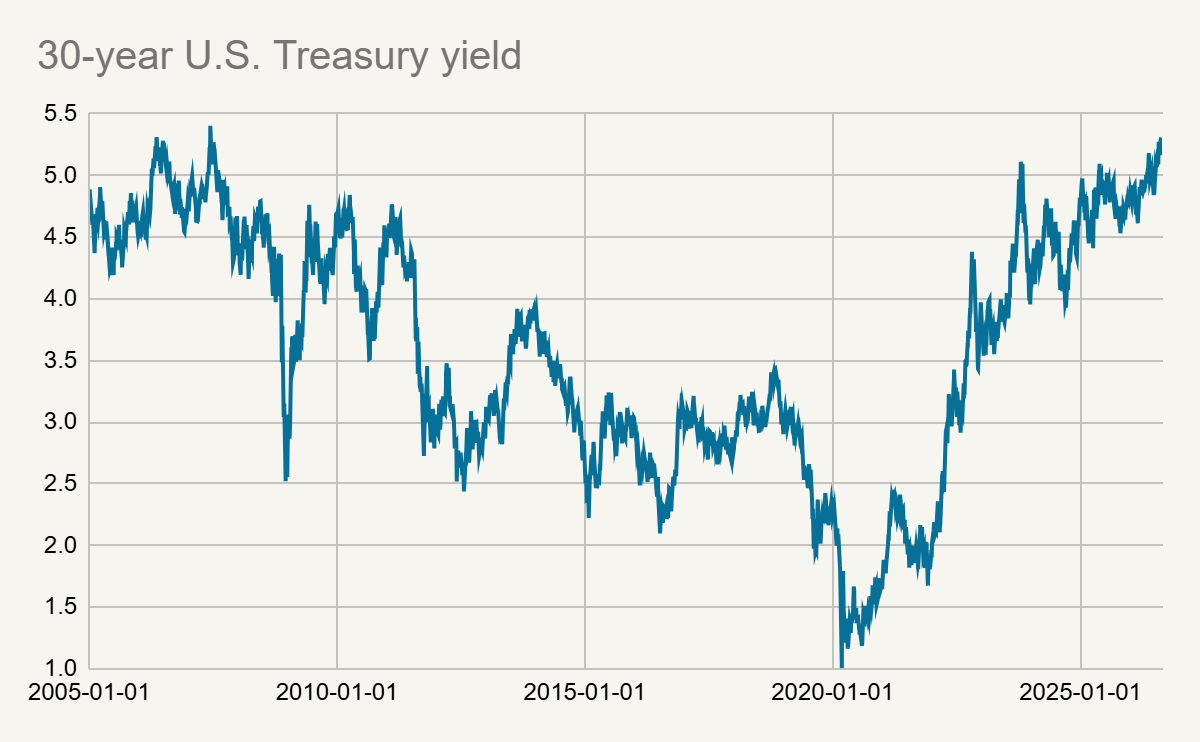
We can see that investors have been pricing in these risks by looking at the 30-year Treasury bond yield. This yield hit a multi-decade high on August 17 at 5.31% before pulling back slightly thereafter.
Source: Bloomberg
As you think about the concerns in the bond market today, try to remind yourself that these risks are why bond yield are currently high. They aren’t automatically reasons why bond yields will keep going higher.
If the Fed hikes rates, will bonds lose money?
Not necessarily. While past hikes have caused volatility, historical data shows that broad bond markets can still generate positive returns during rate hike cycles.
Investors are understandably scarred from the large losses bonds suffered in 2022. That year the Morningstar U.S. Core Bond index, a broad index of U.S. bonds, lost 13%, by far the worst year in the history of that index. Losses in that year were indeed a result of aggressive Fed rate hikes in an attempt to quell inflation.
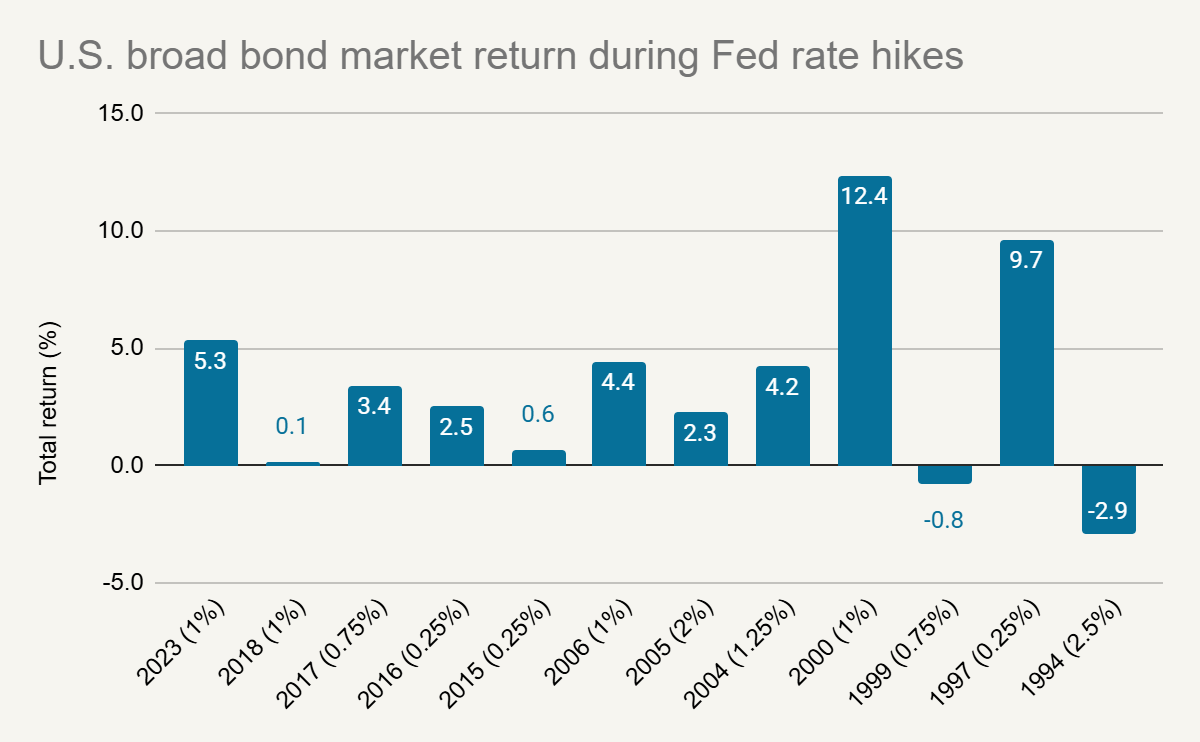
However, Fed rate hikes don’t usually result in negative years for the broad bond market. To put this into perspective: in the 12 years the Fed hiked interest rates since 1994 (excluding 2022), broad bond market returns were positive in 10 of those years. The chart below shows each of these years and the bond market return for that year. Next to each year, we put the amount of Fed hikes in parenthesis.
Source: Morningstar
You can see only two out of these twelve years were bond returns negative. This is partly because investors anticipated the hikes, and therefore they didn’t cause significant negative price movement. It is also partly because income generation from the bonds offset any negativity from rising rates.
Note that for bonds to suffer the losses they did in 2022, it took an extraordinary confluence of events that is unlikely to repeat in 2026 or 2027.
- COVID masked real inflation pressure: Inflation started rising in 2021, but it initially appeared to be caused by COVID-related supply disruptions that would naturally fade away as the economy reopened. Therefore the bond market assumed inflation would quickly subside in future years.
- The Fed hiked rates by 5.25%: This is the most aggressive rate hiking cycle in the Fed’s history. Today the market is anticipating something like 0.5-0.75% worth of hikes over the next 18 months.
- Bond yields started extraordinarily low: At the start of 2022, even longer-term Treasury bonds were below 1.5% in yield. This meant there was very little income generation to cushion the effects of rising rates. Today, the overall yield on the Morningstar bond index is 4.95%. That income could offset quite a bit of negative price return.
While it is certainly possible bond portfolios suffer losses in the future, we don’t think it is helpful to overrate the experience of 2022. The specific factors that led to such unusual and severe bond market performance aren't likely to be repeated. Certainly today’s conditions don’t match that period in any meaningful way.
Does the growing Federal debt make bonds risky?
The U.S. debt levels are still well in range of other large world economies, and is not yet at an unsustainable level. However the large amount of bonds that need to be sold to the public probably are putting upward pressure on bond yields.
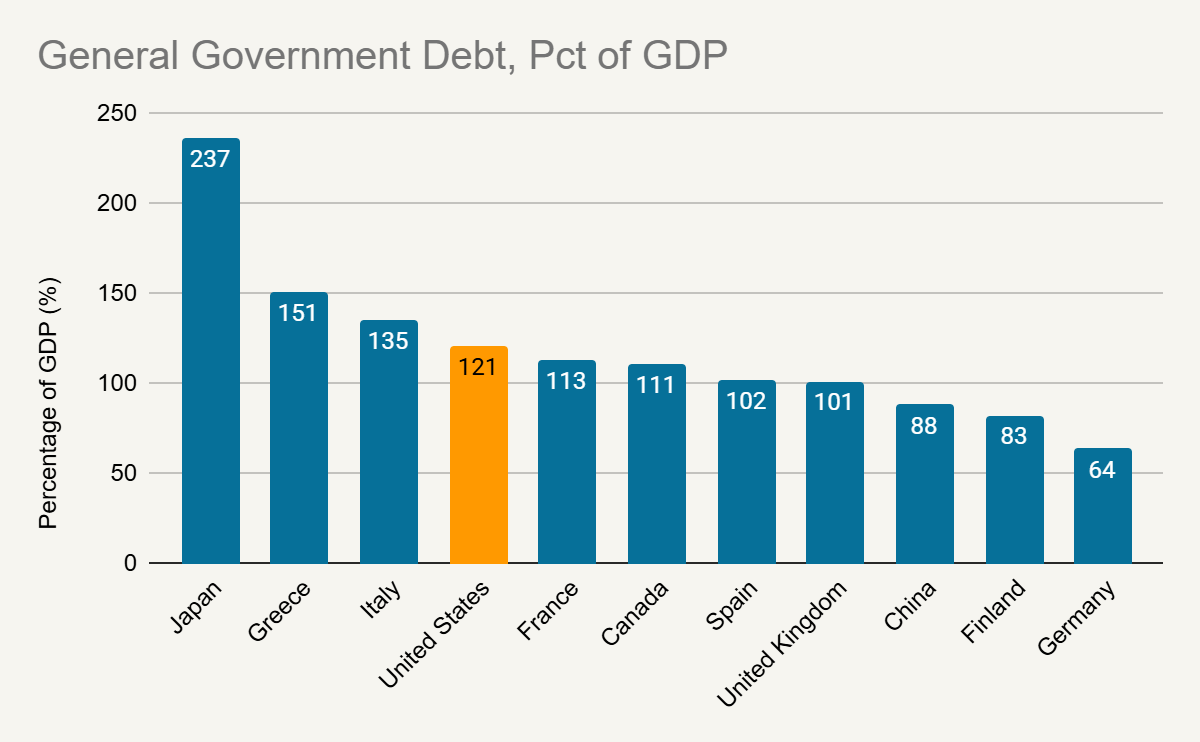
It is often said that the U.S. is on an unsustainable fiscal trajectory, and this is hard to argue. This is different from saying the U.S. is in a crisis right now. A recent study by the University of Pennsylvania suggests the U.S. would hit a breaking point at debt levels equal to 210% of GDP. Federal debt is currently about 101% of GDP, which rises to about 121% when you include state and local government debt, according to IMF data.
The U.S. debt load has been rising in recent years, but remains similar to other major developed market countries.
Source: International Monetary Fund
Right now, bond yields aren’t being influenced much by the U.S.’s overall debt level per se. Rather, it is the amount of bonds that the Treasury is selling to the public. Bond yields are set by supply and demand, just like any other price. During the month of September, the Treasury will be selling $405 billion in notes and bonds to the public. The yield on those bonds needs to be high enough to attract buyers for all of those bonds. Moreover, all those buyers know that the Treasury will keep selling bonds at an elevated pace for the foreseeable future.
Exactly how much bond supply impacts Treasury yields is difficult to cleanly measure. One oft-cited paper by Erin Engen and Glenn Hubbard suggests that for every 1% increase in debt to GDP, bond yields rise by around 0.02-0.03%. This roughly means that if the U.S. debt went from approximately 120% of GDP to more like 140% of GDP, bond yields would be between 0.4% and 0.6% higher, all else being equal.
Note that government debt isn’t the only kind of bond supply that matters. So far in 2026, investment-grade corporate bond issuance is running 27% ahead of last year’s pace, driven mostly by tech companies funding data center construction. That is also putting some upward pressure on interest rates.
However, note that all of this is incremental. In any given year, other factors are almost certainly more important for bond market returns - things like Fed activity, the state of the economy, etc.
Could foreign holders start selling Treasury bonds?
Historically, concerns about foreign governments rapidly selling off U.S. Treasury bonds haven't translated into major market disruptions. China has been a net seller of Treasury bonds for many years without a noticeable effect on Treasury yields.
Foreign governments that hold Treasury bonds generally do so as part of managing their own currency. They may accumulate U.S. dollar assets when the government is trying to weaken the currency, i.e., sell the local currency and buy dollars, which get recycled into U.S. bonds. The opposite happens when a government is trying to strengthen the currency: sell dollars, buy their own currency.
China is a great case study in this. For most of the 2000-2015 period, China was trying to prevent the yuan from appreciating too rapidly. This resulted in China accumulating more than $1.2 trillion in Treasury bonds over that period, according to Treasury Department data. Since then, the Chinese yuan has turned weaker, accelerating around 2021 when the Chinese property market went bust. China’s Treasury holdings have been cut in half to just over $600 billion over that period, mostly in an attempt to prop up the yuan.
Today there is some concern that Japan could similarly wind up selling Treasury bonds to prop up the yen. In July, the Japanese yen hit its weakest point in 40 years, prompting a record sized currency intervention by the Ministry of Finance. The U.S. Treasury aided in this intervention in a relatively small way. One motivation for the U.S. to help Japan in this operation might have been to prevent Japanese selling of U.S. bonds. Japan is currently the biggest foreign holder of Treasury securities at about $1.1 trillion.
It is possible that Japan could sell Treasury bonds in the future to support the yen’s value, however it is unlikely they would have to sell in large size. Ultimately, if Japan wants to bolster the value of the yen, the Bank of Japan needs to hike interest rates. The main driver behind the yen’s slide has been the slow pace of rate hikes by the Japanese central bank. Buying yen in the open market is just a stall to let the Bank of Japan catch up.
On net, there is no evidence that foreign holders of Treasuries have been major sellers. According to the Treasury Department, foreign ownership of Treasury bonds has increased 24% over the last five years, with selling from the Chinese government offset by other countries.
Should I hold cash instead of bonds?
Cash feels safer than bonds, but you give up a lot of return. We don’t believe this tradeoff is worth it for most investors.
With all this talk of risks in the bond market, it might be tempting to consider reallocating your bonds to cash instead. After all, if bonds are supposed to be your stability asset, why not just buy the ultimate stability asset instead?
The problem is you are giving up more in return potential than you are gaining in stability. As of September 1, 2026, the yield on the Morningstar Core Bond index is 5.0%. This is a good proxy for the yield of typical high-quality bond allocations. The yield on high-yield cash accounts right now is around 3.5%.
Giving up 1.5% in return every year waiting for a bad bond market could wind up being costly. Remember that most really bad years for bonds historically have only been 1-3% losses. By going to cash, you start out giving up 1.5% in income. If you have to wait more than a couple years for that bad market to come, you could wind up giving up more in lost income than you gained by avoiding the down market.
It may make sense to hold a certain amount of cash or equivalent investments as part of a broader financial plan, but we don’t recommend doing that as part of a kind of market timing exercise. Moreover, if you are worried about rising rates you might want to consider lower-volatility alternatives, such as Facet’s Alternative Income program. This could help add some interest rate stability without giving up as much in expected returns compared to traditional bonds. This strategy has other risks, including liquidity and credit risk. That means it isn’t a full bond substitute, but it can be a very effective compliment, especially for bond-heavy portfolios.
Do bonds still belong in my portfolio?
While bonds are not without risk, they are still very likely to be a stabilizing force in a mostly stock portfolio, and therefore are an important tool in portfolio construction.
A traditional retirement-oriented portfolio has utilized stocks for growth and bonds for stability. In other words, you own stocks to get asset appreciation, but you know that stocks will suffer 20%+ downturns from time to time. During those big down markets, you want some more stable part of your portfolio to avoid selling stocks in down markets and locking in those losses.
Bonds should still serve that purpose well in most kinds of down markets for stocks. Consider that stock prices are fundamentally a function of company profits. Most bear markets for stocks are driven by a surprise decline in profit growth. The most common reason for that to happen is that the economy is in a recession. When the economy is in a recession, the Fed is probably cutting rates, which tends to boost bond prices.
That basic relationship between stocks and bonds hasn’t changed just because bond supply and/or inflation are relatively high.
There is a risk that more volatile inflation could influence the Fed’s activity. For example, if inflation has more frequent spikes above 3% over the next decade, the Fed may wind up with more frequent hiking/cutting cycles. It is possible this results in bonds having a somewhat higher correlation with stocks, as rapid Fed rate hikes tend to be negative for both stocks and bonds.
The risk of possibly higher correlations between stocks and bonds is the main new risk we are considering when building portfolios today. It is partly why we have decided to be underweight very long-term Treasury bonds. It is also the genesis of strategies like Alternative Income.
However, we don’t think this risk of higher correlations fundamentally changes how bonds fit within portfolios. Bonds are not without risks, but they should still be substantially more stable than stocks, especially during down markets.
Investing in fixed-income securities involves risks, including interest rate risk, credit risk, inflation risk, and the possible loss of principal. Alternative investments, including Facet’s Alternative Income strategy, involve specific risks including illiquidity, credit risks, and limited transparency, and are only available to members in the Plus and Complete membership tiers. Given the securities held in the Facet Alternative Income strategy, you must meet the standards of an accredited investor, as defined by the SEC, to invest in the strategy.