The Federal Reserve made no changes to its interest rate target at their July meeting, but change could be coming. Not only is inflation running well above the Fed’s target, but it is clear some members of the Fed’s committee are ready to hike now. Here is why we think rate hikes could be imminent and what it means for financial markets and your money.
Why is the Fed considering hiking interest rates?
Inflation is currently well above the Fed’s 2% target, and Fed Chair Kevin Warsh has pledged to get inflation back down under control.
The Fed has two mandates, given to it by Congress: stable prices and full employment.
- Stable prices: The Fed has defined “stable prices” as inflation running at 2% over the “longer-term.” At this point, it is difficult to say that the Fed is meeting that stable prices mandate. The Fed’s favored inflation measure, Core PCE, has been above 2% every month since 2021, most recently measured at 3.4%. What the Fed means by “longer-term” isn’t any particular number, but five years certainly seems like a long time.
- Full employment: Whether the Fed is achieving the employment mandate is a bit murkier. The economy has added an average of 92,000 jobs per month in 2026. That’s a slower pace of growth than the U.S. has typically seen during non-recessionary periods. However it is considerably better than the 10,000 per month average from 2025. In addition, the unemployment rate has been steady between 4-4.5% for the last two years.
Since taking over the Chair from Jerome Powell, Warsh has consistently stated a desire to address inflation. The press release from the July meeting states flatly that “The Committee will deliver price stability.” During his press conference, Warsh repeated this line, and added that the Fed was not willing to tolerate inflation above the official 2% target. “Let me reiterate: There is no soft inflation target. There is no soft implicit target, not on this committee’s watch.”
In our view, the Fed is more focused on inflation right now than employment. Note that Warsh barely even mentioned unemployment during his prepared remarks, focusing almost entirely on inflation. Price stability appears to be their top priority.
Why didn’t the Fed hike rates at the July meeting?
The Fed didn’t hike in July partially because it wants to be sure a rate hike is necessary before acting.
Given all of the concerns Warsh has expressed over inflation, one might wonder what is he waiting for? Why not just hike rates right now?
One answer is that the Fed isn’t yet sure a rate hike is necessary. During the press conference Warsh said “Our thinking about how best to achieve that [inflation] target is advanced, and over the coming months, I expect it to be advanced more significantly.” This is clearly a hint that a hike is pretty likely sometime this year, but not yet certain. The Fed probably wants to be absolutely certain before acting.
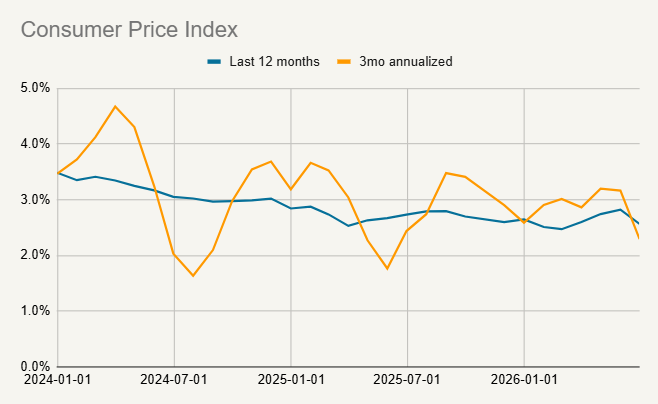
The June Consumer Price Index may have bought them some time. Although it is not the series the Fed uses as their official inflation measure, CPI does have most of the same components and similar weights as the PCE inflation report. For the month of June, Core CPI was unchanged. That could be an indicator that inflation is starting to naturally subside.
Source: Bureau of Labor Statistics
In particular, the relatively benign June report could be a sign that if oil prices can subside, maybe core inflation will subside also. Remember that for the month of June, oil prices dropped 20%. They have risen again as the ceasefire in Iran ended, but could very easily fall again should peace negotiations resume.
The Fed may be just trying to buy some time to see how lasting the impact of higher oil prices is on inflation. Hiking rates can have negative effects on the economy, and they may just want more certainty before acting.
Why does Kevin Warsh want to eliminate forward guidance?
Warsh is keen to eliminate the concept of forward guidance, in part because it will allow markets to react to real economic data as opposed to focusing on the Fed’s statements.
During his press conference, Warsh highlighted that Treasury bond yields had risen significantly since the last Fed meeting. He described this as the market “learning to play the ball, not the referee.” In his analogy, the “ball” is economic data and the “referee” is the Fed. Warsh said this was a “change for the better.” He believes this will give the Fed better signals about what the market thinks of the economy.
In our view, there is a sense in which this is probably right, but a sense in which it may be circular logic. During Jerome Powell’s Chairmanship, the Fed was very focused on not surprising the market. Therefore it may be true that investors started paying more attention to what Powell said, and less to economic data. Warsh is arguing that this interferes with key signals the Fed wants. Every piece of economic data has nuances and complexities. One way to cut through the complexity is to watch how the market reacts.
For example, say the next employment report has a mediocre total job gains figure, but a significant drop in unemployment and an above-expectation wage growth rate. How does one know which of those elements are more important? In such a scenario, it is helpful to see the market’s reaction. If Treasury bond yields rise, it may mean the market has concerns that the fast wage growth could be inflationary. If Treasury yields fall, the market is saying the soft total job gain is more important.
This is what Warsh means by market signals. These signals get muted, or perhaps even eliminated entirely, if traders merely focus on the Fed’s forward guidance.
However, there is an element of circular logic to this. Regardless of whether the Fed gives guidance or not, the market is still trying to anticipate the Fed’s future moves. In other words, if Treasury bond yields are rising, that is in part because the market believes the Fed will be hiking rates in the future. Under Powell, the market’s expectations were indeed heavily influenced by the guidance the Fed gave it.
Without forward guidance, the market is still trying to guess the Fed’s future moves. The only difference is that traders have less information to go on. In other words, it is more of a guess than it was before. That may indeed give the Fed some better signals. However the signal is still what the market thinks the Fed will do. Not some pure, unadulterated market viewpoint.
Do stocks tend to fall when the Fed hikes rates?
Stocks have historically performed perfectly fine during rate hiking cycles. Since 1990, the S&P 500 has produced an average of 9% return in years where the Fed hikes rates. How stocks will perform looking forward probably depends on how the economy responds to any rate hikes.
Stocks fell significantly after Warsh’s press conference was complete. The S&P 500 went from about unchanged to down 1.5% from 3pm to 4pm the day of the Fed meeting. This move probably wasn’t solely about the Fed, but some of this decline is probably related to worries about rate hikes.
The relationship between Fed rate hikes and stock market performance is complicated. When the Fed is hiking rates because the economy is strong, stocks tend to take it in stride. As we said above, stocks usually rise during hiking cycles, because generally the Fed starts hiking during good economic times.
The story could be different if the Fed is forced to wring inflation out of the economy. Inflation is ultimately a product of too much demand chasing too few goods. The Fed uses interest rates to try to curb demand by raising the cost of borrowing. In other words, they intentionally try to create some damage to economic growth in the name of reducing inflation.
This is what happened in 2022, when the Fed was forced to hike rates aggressively to bring inflation under control. The S&P dropped 18% that year.
Today we have nowhere near the inflation problem we had in 2022. That year Core PCE inflation hit a peak of 5.6%. Right now it is only 3.4%. If the Fed can hike once or twice in the next few months and that is enough for inflation to wane, it would likely have little impact on the stock market. If inflation keeps rising for whatever reason, and the Fed is forced to hike several times, that could be more problematic for stocks.
It could be that tech stocks are a bit more vulnerable in such a scenario than other kinds of stocks. Generally speaking, companies that are rapidly growing tend to be more sensitive to interest rates. Moreover, an increasing amount of spending on AI infrastructure and datacenters is being funded with debt. Higher interest rates make those projects more expensive. If that were to cause any kind of slowdown in AI spending, that could be a negative for tech stocks.
How many times will the Fed hike rates in 2026?
We think it most likely that the Fed hikes 1-2 times in 2026, but uncertainty is high, and we believe investors need to be prepared for the possibility of more rate hikes into 2027.
How many times the Fed hikes in 2026 comes down to how quickly inflation starts to slow. Kevin Warsh is focused on regaining control over prices, and is probably less sensitive to financial market volatility than his predecessors. That may mean the Fed is willing to move more quickly today than what might have been true during Jerome Powell’s tenure as Chair.
The most obvious variable is oil prices. At the end of June, oil prices had fallen all the way to $69 on hopes that a lasting peace could be found in Iran. Since the end of June, both sides have resumed strikes on each other, leaving peace in doubt and causing oil prices to jump back above $90. The higher oil prices go, the more pressure there will be on the Fed to keep hiking.
However, oil isn’t the only variable. Weakness in the jobs market could give the Fed pause. Conversely, if job gains pick up, it could result in faster wage increases which could also fuel more inflation.
As we said, uncertainty is high, but most signs point to at least a couple rate hikes in the coming months, with the balance of risks pointing to potentially more hikes before inflation subsides.
Disclosure
This article is intended to be an analysis of current market news only. It is not intended to be advice, a recommendation or any type of forward guidance. Investing carries inherent risks including the loss of principal and past performance is no guarantee of future results.