Take control of your finances. Join now and get up to $1,100 in SAVINGS.* Book your call today.


How our Chief Investment Officer would invest $100,000 windfall.

The short answer:

If you receive a sudden windfall of $100,000 for a long-term goal like retirement, investing it all at once into a highly diversified portfolio of broad ETFs can help you capture the market’s general upward movement over time. This approach sets aside timing biases and focuses on long-term growth, which is essential since stocks historically rise about 8 out of every 10 years.

Tom YT Thumbnail If I Had $100K this is what i would invest in

Jump to a section:

Key takeaways:

  1. Long-term investing: Since I still have time before retirement, I’d invest primarily in stocks to max out growth over a long horizon.
  2. Lump-sum investing: Investing a windfall immediately typically outperforms waiting, as "time in the market" is more beneficial than trying to "time the market."
  3. Diversification: Use broad ETFs (exchange-traded funds) to create a highly diversified portfolio, minimizing risk and capturing consistent market growth.
  4. Risk management: Balance high-risk investments with a diversified core portfolio, ensuring long-term financial goals remain secure.

One technique professional investors use to analyze their portfolio is to ask themselves: what would I invest in if I started from scratch? This sets aside all biases around what you currently own, and forces you to think fresh.

In this piece, we’ll do a version of this exercise. I will walk through how I would invest a sudden windfall of $100,000 today.

Investing for growth

To set the parameters, we’ll assume this money is for a long-term goal, like retirement. If we were saving for some shorter-term goal, this could all change. This is how I’d invest $100,000 for long-term gains.

I’m also speaking strictly for myself here. Everyone’s personal situation is different, so my advice to you could be quite different than what I’d do myself. I’m 47 years old, and I have a great job. I plan on working a long time to come.

Given all that, I’d put the $100,000 entirely in stocks. Not only do I have a fairly long time horizon before retirement, I also assume that even after I retire I’ll be living off that money for a long time. I need this money to grow, and stocks are the easiest way to achieve that.

Timing matters less than you think

Second, I would invest the money all at once. I know this might seem extreme to some. In my years in the investment business, I’ve known many people who had sudden windfalls. Overwhelmingly, they were very hesitant to put this new money into the market in one fell swoop.

However, the data says that waiting to invest tends to cost you. Historically, stocks have risen about 8 out of every 10 years. Of course, history may not repeat itself. But if that history is correct, it suggests that you have about an 80% chance that waiting to invest costs you.
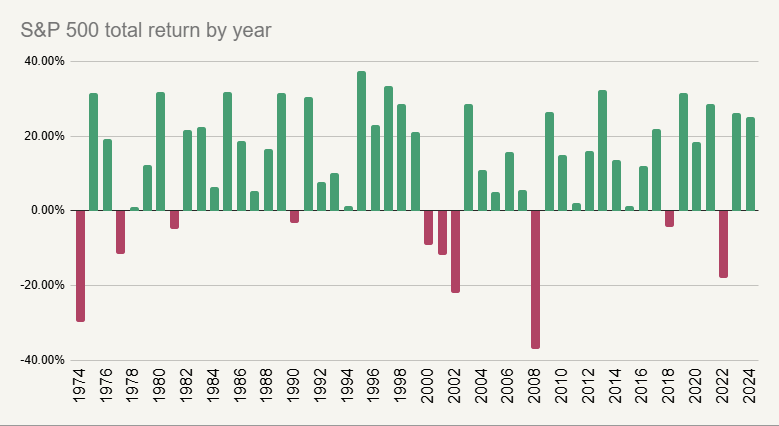
Source: Dow Jones S&P Indices

Admittedly, it's certainly possible that this coming year will be one of the 2 out of 10 where stocks fall. However, this actually matters less than most people think.

If you’re going to be a long-term investor, you’re going to go through some bad markets. It actually doesn’t  matter what the timing of the bad markets are, assuming you aren’t adding or withdrawing from your account.

Here is the math behind this. Say that we invest for ten years, and in eight of those years, the market returns 15%. In two of those years, the market declines by 20%. The chart below shows the value of $100,000 invested in two scenarios. The blue line assumes the negative periods happen in years 7 and 9. The grey line assumes the down markets happen in years 1 and 3. You can see that both scenarios wind up in the same place.
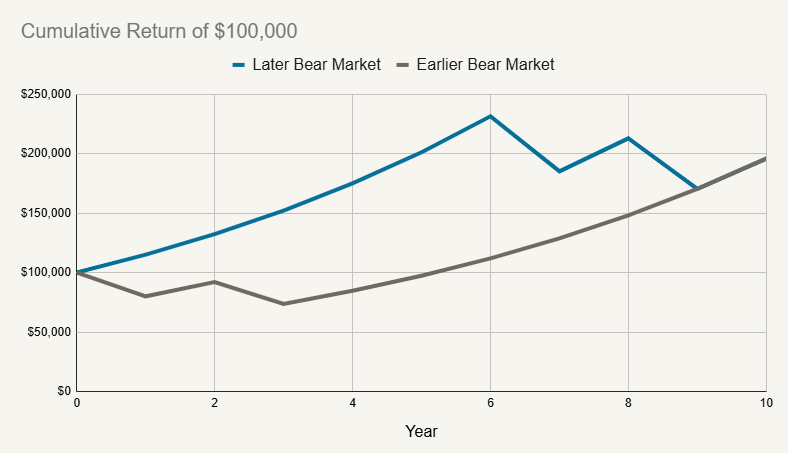
Source: Facet calculations

Bear in mind that if you're actually adding or withdrawing from your portfolio, this math changes quite a bit. If you're continuing to add, it actually is better if the negative markets happen sooner. Future buys will occur at a lower level. If you're withdrawing, that’s a more complicated situation, and requires careful planning. This isn’t something we are going to cover in this article, but it definitely something that Facet can help you navigate.

Making the easy bet

I would invest my $100,000 in a highly diversified portfolio using broad ETFs. I believe the more diversified you are, the more likely your portfolio will capture the general upward movement in stocks over time. The most important thing to me is that when I do retire, I can afford to live the life I want to live. If I invest in a  more narrow portfolio, even something like an S&P 500 fund, I’m taking more risk.

I would be the first to admit: this might sound pretty boring. It's true that if I buy a set of globally diversified ETFs, there’s no chance I turn my $100,000 into $1 million in a short period.

However, one thing I’ve learned over my 25 years in the investment business is that success comes from finding the easiest bet you can make. Then make that bet over and over. When it comes to investing in stocks, the bet I’m most confident in is that stocks will generally rise over time. To me, that’s the “easy bet” and the one I want to make over and over.

What if you want to take a bit more risk?

All of that summarizes what I’d do if I had a sudden influx of $100,000. However, this isn’t the only way to do it. In fact, I’m sure a lot of people would take at least some of that money and invest it in something with more risk but maybe more upside. Could be an individual stock, some set of stocks or even crypto.

If you're considering such an investment, be sure you size that bet right. One approach is to separate your portfolio into two buckets: a higher risk bucket that you can afford to lose, and a more diversified bucket that is meant to make sure you meet your goals.

Make the “meet my goals” bucket large enough that you’re going to be able to retire on time, even if the other bucket doesn’t contribute at all. Or put another way, make the high risk bucket small enough that even if it loses half its value and never recovers, your financial goals aren’t totally ruined.

Sometimes boring is best

As I said, I realize my $100,000 investment plan isn’t very exciting. But for me and my situation, I feel most confident that a boring plan is actually best. I could chase big gains, but I’d rather give myself a pretty high probability of hitting my long-term goals, and someday, a very long time from now, enjoying my retirement.

Ready to get more organized and have more clarity with your money? Schedule a free call with Facet. We’ll show you how a personalized financial roadmap, built for you by a CFP® professional, can turn your money into a tool to help you live a better life today, and feel more confident about tomorrow.

FAQs

It’s generally better to invest the money all at once because historical data shows that waiting to invest tends to cost you. Since stocks have historically risen about 8 out of every 10 years, delaying your investments means you face an 80% chance that waiting will work against your long-term roadmap.

If you’re a long-term investor who isn’t actively adding or withdrawing from your account, the timing of bad markets actually doesn’t matter. Whether the negative periods happen early on or later in your journey, the math shows that your portfolio will wind up in the exact same place over a ten-year period.

You can manage higher-risk investments by separating your money into two distinct buckets. Keep a larger, diversified bucket to ensure you can meet your retirement goals, and keep the high-risk bucket small enough so that even if it loses half its value, your overall financial roadmap isn’t ruined.

About Facet

Facet is a national, SEC-registered investment advisor (RIA) and consumer fintech leader dedicated to making expert financial planning accessible to everyone.

Through a transparent, flat-fee membership model, Facet provides objective guidance designed to put the member’s best interest first—always. Unlike traditional firms that often take a cut of your returns or charge by the hour, Facet’s affordable fee doesn’t change even as your money grows, helping you keep more of your own money for the life you want to live.

Facet combines user-friendly technology with a dedicated team of CERTIFIED FINANCIAL PLANNER® professionals to deliver a personalized roadmap for every aspect of a member’s financial life. This comprehensive approach covers everything from the big milestones to everyday decisions—including investment management, tax strategy, equity compensation, and estate planning—evolving as your life and opportunities unfold. Facet’s mission is to empower individuals to move beyond “standard” advice, helping them make confident decisions and live more enriched lives through financial planning the way it should be: simple, guided, and all about you.

Explore more articles

A wooden podium featuring the Federal Reserve seal, flanked by the United States flag and the Federal Reserve System flag against a dark blue curtain backdrop

Will the Fed hike rates? Takeaways from Kevin Warsh’s first meeting

The Federal Reserve held their first meeting with Kevin Warsh as Chair on June 17. Warsh comes into the job with many challenges. Warsh himself has said he wants a “regime change” at the Fed, and said he plans on being “reform-oriented, abandoning old models.” Now that he is Fed Chair, we’re going to find ... Read more

6 Min Read
Woman using laptop at home

How do I perform an insurance review?

We all want to feel secure knowing that the people and things we love most are protected. Life moves incredibly fast, and the safety net you put in place a few years ago might not match the life you are building today. Taking a little time to align your protection with your current world brings ... Read more

4 Min Read
Two diverse colleagues traders talking to each other, looking at graphs while sitting in the office in front of multiple computer screens.

Why picking individual stocks usually underperforms the market

A vast body of data suggests that picking winners in the stock market is extremely hard. Academic research in the 1960’s and 1970’s first provided some evidence that most active portfolio managers fail to outperform the broad market. This led to the popularization of index funds during the 1980’s and 1990’s, which continues today. However, ... Read more

5 Min Read

Get started

To schedule a free consultation with a Facet expert, fill out the form below and we will contact you within 24 hours.

This field is for validation purposes and should be left unchanged.
This field is hidden when viewing the form

By submitting this form, you acknowledge that you have directly provided the email and phone number contact information listed, further acknowledge that Facet Wealth has the option to use either method to contact you, and agree to the terms set forth in our Company Privacy Notice. Message frequency varies, and message and data rates may apply. Reply STOP to opt-out of messages, and email [email protected] for help

OR
To speak with someone now, call us at
1-888-826-6401