
On February 26, the national average 30-year mortgage rate fell below 6% for the first time since 2022. Since then, war broke out in Iran, causing all kinds of interest rates to lurch higher, from Treasury bond yields to mortgage rates. This has been frustrating to many who are either looking to buy a home or hoping for a chance to refinance their existing mortgage. What is behind rising interest rates? What might cause mortgage rates to fall again? Here are our thoughts on the current state of the mortgage market.
Why are mortgage rates rising?
Mortgage rates are rising primarily because they are tied to Treasury bond yields, which have surged due to shifting expectations around Federal Reserve rate cuts following the outbreak of war in Iran.
About 70% of all U.S. mortgages are packaged into bonds and sold to investors. Investor demand for these bonds is what effectively controls the mortgage rate your bank offers you. The vast majority of these bonds are guaranteed by U.S. government agencies, which means they compete with Treasury bonds for investors’ capital. This in turn means that mortgage rates tend to move up or down in tandem with Treasury bond yields. In other words, mortgage rates have been moving higher since the Iran War began because Treasury yields have also been moving higher.
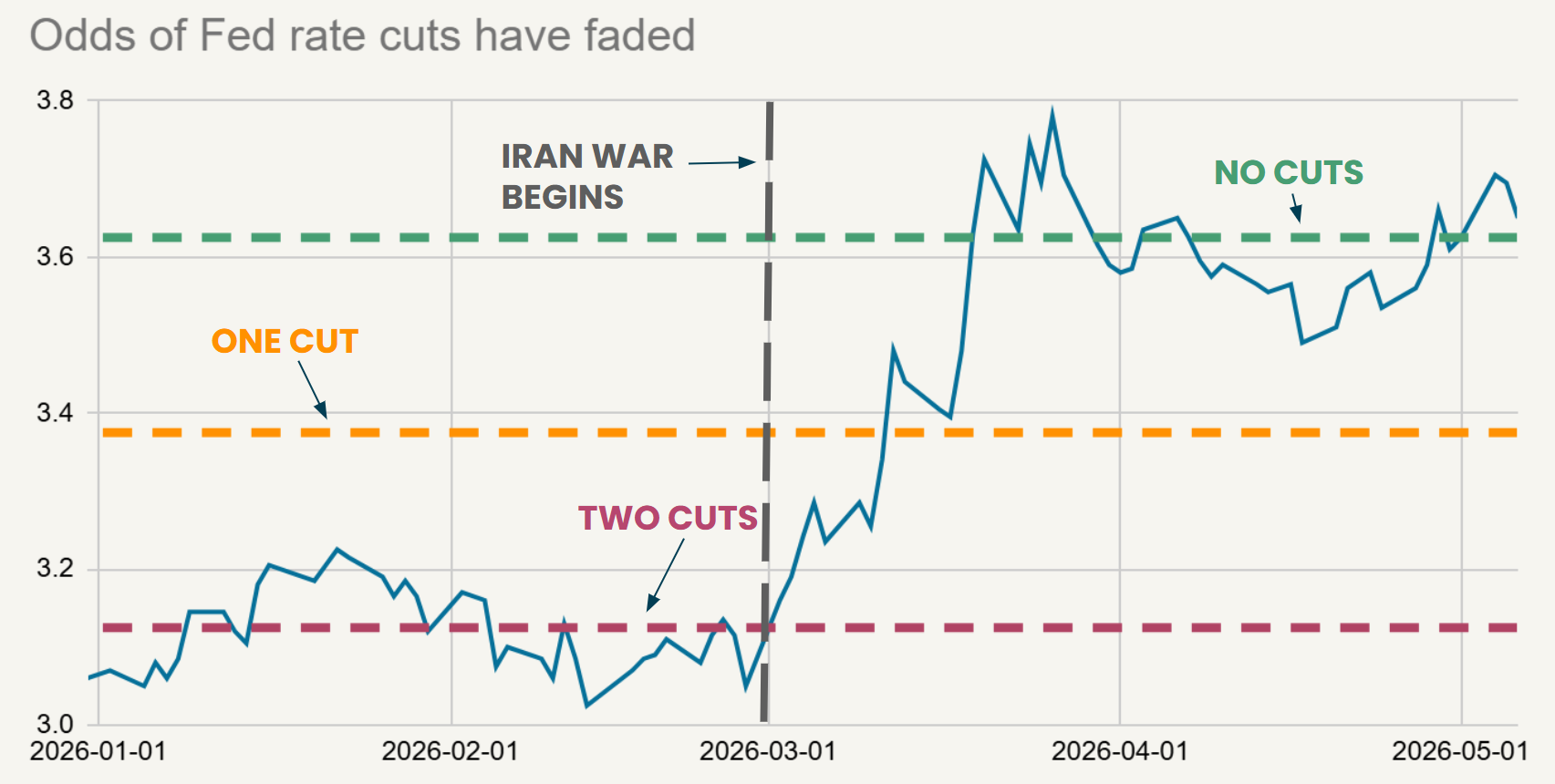
The main reason why Treasury yields have been rising is due to the shifting outlook for Federal Reserve rate cuts. The chart below shows how futures contracts on what the Fed’s target rate will be at the end of 2026 have shifted since the war began.
Source: CME Group
As the chart shows, prior to the Iran War, the market was anticipating two rate cuts by the end of 2026. Quickly after the war began, traders shifted their outlook. As of May 6, traders are anticipating no cuts at all. In fact, the blue line lying slightly above the “no cuts” area on the graph, this suggests traders are guessing there is some small chance of a Fed rate hike sometime this year.
Is Kevin Warsh going to cut rates?
This may be surprising if you have been following the news around Kevin Warsh, who has been nominated to succeed Jerome Powell as Fed Chair. President Donald Trump has made no secret that he wants the Fed to cut rates. Over the last year, Warsh has suggested repeatedly that he thinks indeed rates should be lower, in part due to an anticipated productivity boom from AI. Ostensibly, this willingness to cut rates is a major reason Trump selected Warsh for the job.
For now, current market indicators suggest investors doubt Warsh will follow-through with rate cuts. There are three, somewhat related reasons.
- Spiking oil prices: While the Fed usually excludes food and energy prices when measuring inflation, oil prices have spiked about 50% since the war began. A change of that magnitude could cause broader inflation pressures.
- Warsh’s own history: In 2008, Kevin Warsh was a member of the Fed’s rate-setting committee. That summer there was a similar spike in oil prices. At the time Warsh expressed considerable worry about inflation risk, even as the economy appeared to be weakening.
- Skepticism within the Fed: The Fed is a democratic body. Warsh can’t just cut rates on his own - he needs a majority of the Fed committee to agree. Right now there seems to be little support for near-term rate cuts within the Fed.
Is the deficit impacting interest rates?
While a growing national deficit can put upward pressure on interest rates by increasing the supply of Treasury bonds, it is unlikely to be the primary driver of the recent jump in mortgage rates.
The larger the U.S. debt gets, the more Treasury bonds need to be sold to the public. As with anything else, growing supply of something tends to cause its price to go down. In the case of bonds, a lower price means a higher interest rate. As we said above, anything that moves Treasury bond rates also impacts mortgage rates.
It is also true that the Iranian War will probably cause the deficit to widen by some degree. Current estimates of the cost of the war range between $25 and $50 billion dollars according to U.S. officials. If the government needs to sell $50 billion more in bonds, that may have some effect on interest rates.
However, it is unlikely this is a major reason why interest rates have jumped since the war began. According to the Securities Industry and Financial Markets Association (SIFMA), there are about $30 trillion in Treasury bonds outstanding. Adding another $50 billion to that total probably doesn’t move the needle.
The deficit and the size of the U.S. debt definitely matter in the big picture. If suddenly the U.S. were somehow running a budget surplus, it is very likely that interest rates would be meaningfully lower across all sorts of markets. However, there probably hasn’t been a meaningful effect on rates stemming from the cost of the war itself.
What could cause mortgage rates to drop?
Three primary factors could cause mortgage rates to drop: a substantial decrease in oil prices, a weakening economy, or a cooling of core inflation.
- Oil prices drop substantially: If oil prices could reverse most of all of the post-war increase, that would take the pressure off inflation. This would likely help build support within the Fed for rate cuts. However, worth noting that even if the war ends and the Strait of Hormuz is reopened quickly, there has been significant damage to oil-related infrastructure in the Persian Gulf region. That might keep oil prices elevated for some time.
- The economy weakens: If job growth were to turn negative or consumer spending drops substantially, the Fed may become much more willing to cut rates. Not only will the Fed worry about the labor market itself, it is also likely that a weaker economy would also cause inflation to subside.
- Core inflation cools: As we said previously, the Fed usually focused on so-called “core” inflation, i.e., excluding food and energy. If energy prices remain high, but there is no evidence that is impacting core inflation, Fed officials will warm up to rate cuts. One possibility is that consumers are forced to shift spending from other goods in order to pay for gasoline. That could cause core inflation to cool.
We have said for a while now that a big decline in mortgage rates, such as down into the 5% area, would require a much weaker economy. That would result in the Fed cutting much more aggressively. This would push Treasury bond yields significantly lower, and with that, mortgage rates would decline as well.
Other scenarios, such as oil prices dropping, would probably only bring mortgage rates back to near the pre-war levels of around 6%. That would be an improvement over today’s rates, but probably not a game changer for the housing market.
When should I refinance?
At Facet, we are often asked by our members “when should I refinance my mortgage?” The answer depends on a lot of factors that are unique to your situation:
- What are the fees associated with the refinancing? - Ensure the rate drop saves you enough over time to cover your closing costs
- How much longer is the term of your loan? - When you refinance you “start over” on paying down your mortgage
- How long are you intending on staying in the house? - If you move quickly and pay off the mortgage, your savings may be too small to be worth the fees
- How large is your loan? - Larger loans save more with relatively small changes in mortgage rates
- Has your home appreciated in value? - Sometimes you can refinance away things like mortgage insurance if your home has increased in value
- Has anything changed about your credit since taking out the loan? - You may get extra interest savings if your credit score or debt to income has improved
- Do you have other debts you could pay off with a home refinancing? - This may make a cash-out refinancing worth it even if interest rates haven’t dropped much
All of these factors, and perhaps some others, should go into your consideration when thinking about a refinance of your mortgage. However, one thing we suggest you avoid is trying to time interest rates. If we rewind to February of this year, mortgage rates had fallen to about 6%, and news reports were saying that the new Fed Chair might be aggressive about cutting rates. It would have been tempting to hold out on refinancing hoping to get 5.75% or 5.5% if rates kept falling. Now it appears rate cuts are much less likely, and you might have missed your window to refinance at 6%.
This is why, generally speaking, we encourage our members to refinance when there is the opportunity to do so. Don’t try to guess where interest rates are going next.