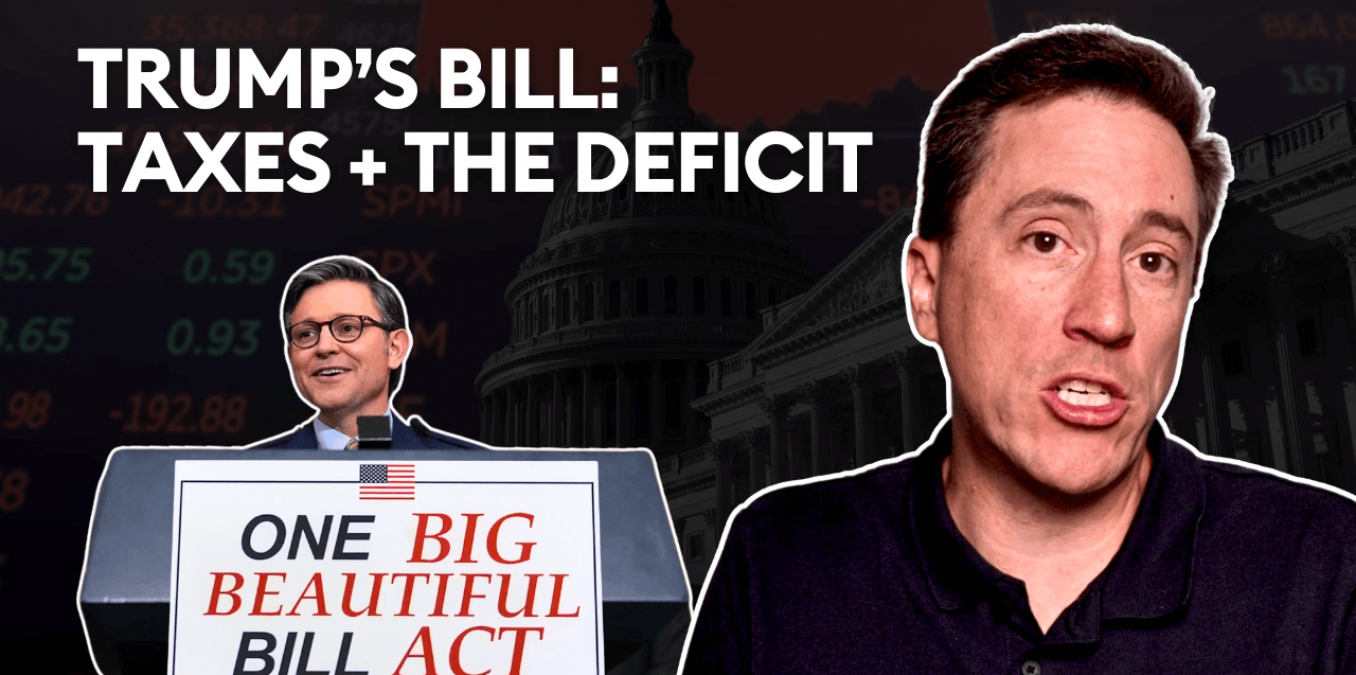
A significant budget deal, officially titled the One Big Beautiful Bill Act, recently passed the House of Representatives. Although the bill will likely go through some major changes as it works its way through the Senate, already this bill is having an impact on financial markets. Investors try to game out how the budget could impact the economy, interest rates and stocks. Here are our views on how this budget could impact your investments.
Tax cuts and their economic effect
The House bill enacts two significant changes related to tax rates. Firstly, it extends the tax cuts originally passed during the first Trump administration. These cuts were scheduled to expire at the end of 2025, and their expiration would have effectively resulted in a tax increase for many. This extension means the current individual income tax rate schedules are set to remain in place for the foreseeable future.
From an economic standpoint, allowing these tax cuts to expire would likely have been a negative for consumer spending. Thus, this aspect of the bill is more about maintaining the status quo rather than introducing a new stimulus, thereby avoiding what markets might have viewed as a negative development.
Secondly, the bill proposes to cut or eliminate taxes on Social Security benefits, tips, and overtime pay. The households most likely to benefit from these specific cuts are those with what economists term a high "marginal propensity to consume." This means that for each additional dollar of income they receive, they are likely to spend a large portion of it. For example, a waiter who retains more of their tip income may be likely to spend most of that extra money.
For the broader economy, this targeted tax relief is expected to have a stimulative effect. However, by boosting demand, it could also introduce a modest inflationary impact.
Deficit implications and complicating factors
Although the proposed budget includes some spending cuts, these reductions are not projected to be sufficient to fully offset the cost of the tax cuts. Current estimates suggest the bill could add approximately $300 billion per year to the federal deficit over the next decade.
However, there are a couple of significant complications to this deficit projection. One is the concept of "dynamic scoring." This approach considers the possibility that tax cuts might stimulate higher economic growth than would occur otherwise. Such growth could, in turn, generate more tax revenue than a simple "static" analysis (which assumes no behavioral change) would predict.
For instance, the Tax Foundation estimated that on a static basis, these tax cuts might reduce federal revenue by about $4.1 trillion over ten years. Using dynamic scoring, however, they project that revenue reduction to be closer to $3.2 trillion, assuming the tax cuts spur additional economic activity. It's crucial to remember that dynamic scoring relies on numerous assumptions, and the actual economic outcome will inevitably differ somewhat.
The other major complicating factor is tariff revenue. President Trump has explicitly said he intends on using tariff income to partially offset reductions in income tax revenue. Since the administration's tariff plans are separate from this budget bill, deficit impact numbers associated with this bill typically do not account for potential revenue generated by tariffs. Some administration officials have suggested that tariff revenue could make up for any shortfall from the tax cuts. In other words, when accounting for tariff income, it is possible that these tax cuts don’t actually add to the deficit.
While this is a possibility, predicting tariff revenue is exceptionally difficult. Consumer behavior will likely change in response to tariff-induced price increases. This will probably lead to reduced imports, which directly affects the amount of tariff revenue collected. This is compounded by the extreme uncertainty surrounding future tariff rates themselves, given ongoing trade negotiations and potential legal challenges. For example, the Court of International Trade recently ruled that the President could not unilaterally impose certain tariffs using a "national emergency" declaration, a ruling the White House is appealing while potentially exploring other avenues for tariff implementation.
Interest rate pressures
Recently, Moody’s downgraded the U.S. Treasury’s credit rating, citing concerns about the ongoing unwillingness in Washington to meaningfully address the federal deficit. While the downgrade itself didn't cause a major market shock, the underlying issues Moody's highlighted are pertinent to this budget discussion.
Historically, the bond market often seemed indifferent to the size of the U.S. deficit. However, since 2020, this has started to change. It is becoming more common for news related to the national debt or deficit projections to materially move the bond market. By extension, it's reasonably clear that current interest rates are generally higher than they would be if the U.S. debt burden were smaller.
This isn't cause for immediate alarm regarding the U.S. defaulting on its debt. Serious global investors are not concerned about getting repaid when they buy Treasury bonds. Rather, the issue is one of supply and demand. With the Treasury needing to sell large volumes of new debt each year to fund the government, it requires progressively higher interest rates to attract enough buyers. The larger the national debt becomes, the more pronounced this effect is likely to be.
All else being equal, persistently high interest rates make it more expensive for individuals to finance homes and for businesses to invest in expansion. So, while the tax cuts described earlier are likely to have a stimulative effect on the economy, if interest rates remain at their current elevated levels or move even higher due to increased borrowing needs, this could act as a significant offsetting drag on economic growth.
Watching the Senate for changes
As mentioned, there's a strong likelihood that this budget bill will undergo substantial changes in the Senate. Several Republican Senators have already voiced criticisms of various aspects of the House bill. Several are expressing a desire for a smaller deficit impact. However, some, like Missouri Senator Josh Hawley, have raised concerns about proposed cuts to Medicare spending within the bill. Given the narrow Republican majority in the Senate (currently three seats), even a small number of defections could derail the bill entirely.
How a compromise will be reached remains to be seen. It does appear that some Senators are paying closer attention to the issue of rising interest rates. Florida Senator Rick Scott and Wisconsin Senator Ron Johnson, for example, have both recently referenced the bond market when expressing their concerns about the budget bill.
Therefore, it would be prudent to anticipate some degree of budget drama over the summer. While there are strong incentives for Republicans to pass some form of tax legislation, it is by no means certain that the "One Big Beautiful Bill" that cleared the House can pass the Senate in its current form.