

Many investors hold cash as part of their portfolio. This could include anything from money at a bank savings account, a money market fund, short-term CDs or T-Bills, etc. There are some situations where a cash position is sensible. It is true that cash-like investments almost never lose money, even over very short periods. However, the returns on cash-like investments tend to be much lower than other options over the long-term. For this reason, holding too much cash can be an expensive proposition in terms of opportunity cost.
When should you hold cash in your investment account?
Yes, there may be good reasons to hold cash-like investments in your portfolio, but this is generally limited to specific short-term planning needs, such as emergency funds, near-term expenditures, or a withdrawal fund for retirees.
Facet generally only recommends holding cash in the following circumstances:
- Emergency fund: An emergency fund is cash set aside to cover unexpected situations, like a job loss or large surprise cost. Facet generally recommends keeping these funds invested in extremely safe assets, like a High Yield Account with FDIC insurance.
- Near-term expenditure: If you are planning on buying a house, a big vacation, a new car, etc. in the near-term, you probably want these savings in something without any volatility.
- Withdrawal fund: Some retirees will set up a cash account to cover some period of anticipated withdraws. This can help potentially avoid selling stocks during a down market while still funding your living expenses.
Even in some of these situations, you may want to consider something other than cash. Something like a high-yield deposit account will never decline in value, but that might be more stability than you actually need. Something like a very short-term bond fund can garner materially more yield than cash, while potentially only adding a modicum of volatility. You want your money working as hard for you as possible, within the confines of taking the right risks, even when considering shorter-term needs.
Should I own cash instead of bonds?
For a long-term investment strategy, cash is generally a poor substitute for bonds. While bonds have experienced recent short-term volatility, they historically offer higher return expectations and generate significantly more income than cash.
Bonds suffered a historically bad year in 2022, with the Morningstar Core Bond Index falling 13%. This seems to have left an impression on many investors, some of whom are turning to holding more cash instead of bonds.
However, we view it as quite likely that diversified portfolios of high-quality bonds will outperform cash over the long-term. History suggests bonds have a major performance advantage over cash.
- Bonds have historically outperformed cash over longer periods: From 1991 to today, bonds have outperformed cash in 83% of rolling 3-year periods, using the Morningstar Core Bond index compared to the Cash T-Bill index.
- Bonds tend to generate significantly more income than cash: While the prices for bonds can fluctuate a lot more than cash, they also usually generate much more income. Right now the yield on the Core Bond index is 5.19%, vs. just 4.09% for T-Bills. In other words, bonds are generating about 1.1% more in income compared to cash, which creates a meaningful cushion to absorb price volatility.
Sometimes investors underestimate how big of a deal an extra 1.1% income generation is. A $100,000 portfolio that returned 5.19% per year would be worth $165,861 at the end of 10 years, while the same amount invested at 4.09% would only be worth $149,310. Or put another way, bond prices would have to fall about 16% over that period for cash to break even. That would imply a significantly worse year than 2022, without any subsequent rebound.
We believe there has been a structural change in interest rates since 2021. We’ve gone from an era of very low interest rates to now an era of higher interest rates. As we have written in other articles, this might come with somewhat more bond market volatility. However, higher yields also could mean higher returns in the future. Arguably bonds haven’t been this attractive for investors in over a decade.
Should you hold cash due to market volatility?
Holding cash to wait for market stability is a form of market timing, which is notoriously difficult to get right. Maintaining a consistent asset allocation, even through periods of volatility, is generally a more reliable approach for long-term investors.
Most people have probably heard that market timing is extremely hard, but that doesn’t remove the temptation to try it. One form of market timing is holding excess cash waiting for market stability.
There are a few problems with this approach:
- There is always something to worry about: Today you might be worried about the Fed, AI, politics, etc. Some of these worries might fade over time, but other concerns will replace them. There will never be a moment where there are no risks in the stock market. If you wait for “stability” you might be waiting a very long time.
- Stock market returns tend to come in chunks: Missing just the 10 best days since 1980 could cut your cumulative return by more than half.
- Stocks start to rebound long before problems are “solved”: The market bottomed in March of 2009, when home prices were still falling and mortgage defaults still rising. The market bottomed in March 2020 long before there was a COVID vaccine. Guessing when these bottoms are coming is extremely difficult. In both these cases, the S&P 500 rose over 20% that month and over 39% in the subsequent three months.
- Some events look scary, but never turn into a crisis: Sometimes the market seems to be headed for a big sell-off, but rebounds just as suddenly. A good recent example was the “Liberation Day” tariff announcement in April 2025. The S&P 500 dropped almost 15% in just three days, only to recover all of those losses in less than a month.
We think it is a lot easier to stay consistently invested, even if it means stomaching volatility, as opposed to trying to time these events. Even if you are in or near retirement, locking in losses by selling at the wrong time could do more damage to your portfolio than just sticking in the market through the ups and downs.
Is buying the dip in stocks a good strategy?
While 'buying the dip' sounds appealing, historical data suggests that holding cash to wait for a market drop tends to underperform staying consistently invested.
You’ve probably heard market pundits talk about “buying the dip” when stocks have dropped. This sounds like good advice. Stocks are down, you are a long-term investor, so why not buy more stocks on sale?
The trouble with this idea is that in order to buy the dip, you need to hold excess cash waiting for the dip to come. Stocks are up most of the time: since 1980, the S&P 500 has produced a positive return in 65% of months, 73% of quarters, and 83% of years. So if you sit on cash waiting for the market to drop, most of the time you will be waiting through some up markets. That might wipe out any benefit of getting the stocks “on sale.”
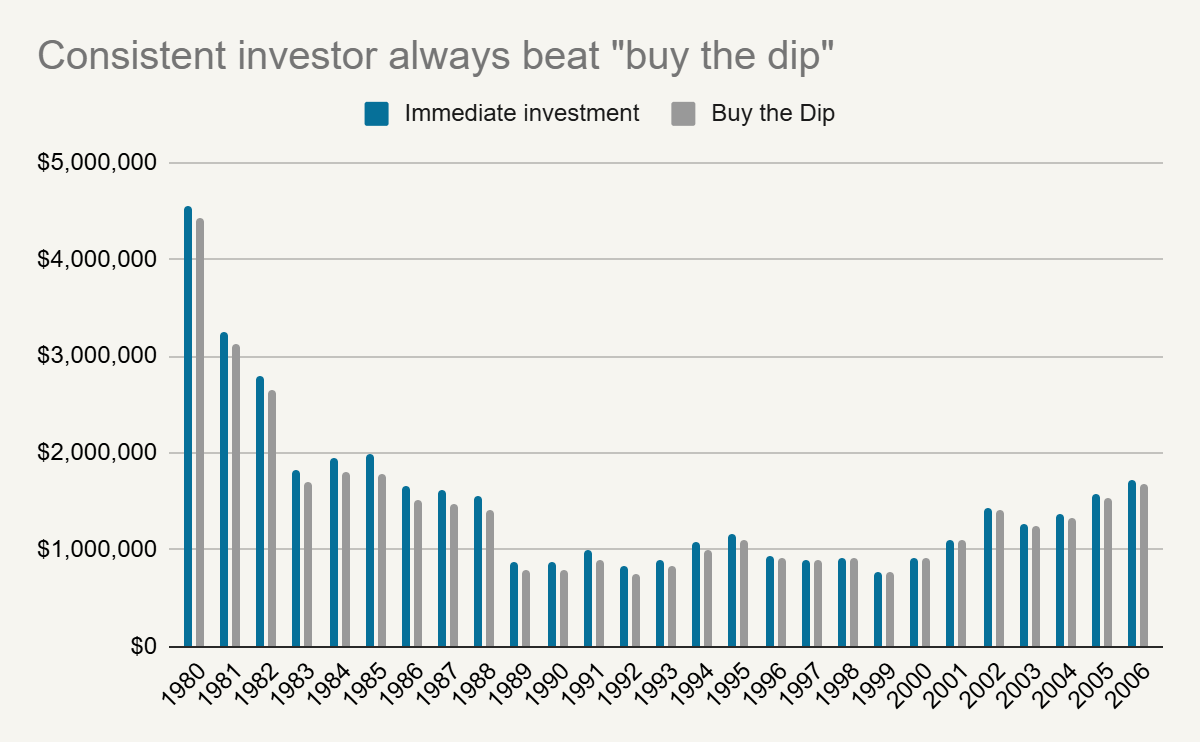
To illustrate this, we tested a simple “buy the dip” strategy vs. a constant investment strategy. For both strategies, we assumed an investor who starts with $100,000 and saves an additional $10,000 at the start of each year. Both investors start out invested in the S&P 500. The constant investor puts the additional $10,000 into the S&P 500 immediately. The “buy the dip” investor waits until the S&P has dropped 10% from any point after the new savings arrives. Any uninvested cash is kept in T-Bills using historic T-Bill rates from the Federal Reserve. Both investors have a 20 year horizon, which we started in each year from 1980 to 2006 to see how often this “buy the dip” strategy would have outperformed.
Source: Dow Jones S&P Indices, Federal Reserve
Over this period, the constant investor won in every case. Take for example the very last year tested, covering 2006 through 2026. That period saw two major crises: the 2008 financial crisis and COVID in 2020. In both cases the market dropped at least 30%. During this period there were several other major downturns, the Greece default, Brexit, Liberation Day, the Fed rate hikes in 2022, etc. And yet despite all of that volatility, blindly buying into the market every January outperformed waiting for a 10% dip.
Can you lose money holding cash?
Yes, you can effectively lose money holding cash due to the impact of inflation. If the yield on your cash investments is lower than the inflation rate, the purchasing power of those funds decreases over time.
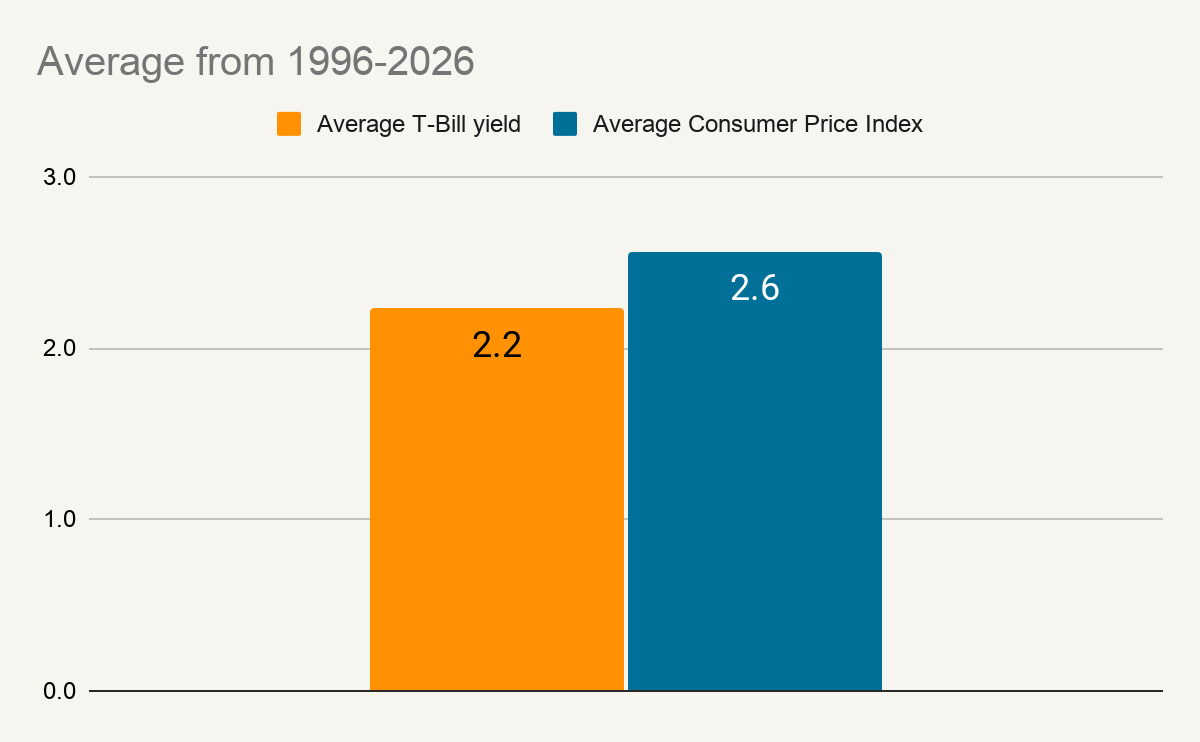
If you plan to use your portfolio to fund future spending, such as your retirement, it needs to keep up with inflation. Historically, yields on cash investments have averaged slightly lower than inflation.
Source: Morningstar, Bureau of Labor Statistics
On average, T-Bill yields have been about 0.4% lower than the rate of inflation. Meaning, holding cash has tended to lose money after adjusting for inflation. It is certainly true that a portfolio of stocks and bonds is likely to be more volatile than cash, but such a portfolio also gives you a much better chance at growth in excess of inflation.
To meet almost any long-term goal, you need portfolio growth that beats inflation. In this sense, cash isn’t safe at all. If the history of the last 30 years repeats itself, cash is likely to detract from your ability to realize your goals.
What is the role of cash in a long-term portfolio?
In a long-term portfolio, cash should generally be reserved for covering specific, short-term liquidity needs. Because cash historically struggles to keep pace with inflation compared to other asset classes, holding excess cash carries a significant opportunity cost.
Cash-like investments should be considered part of a planning strategy. Where you have segments of your assets that you can’t afford short-term volatility cash or similar instruments may be the best choice.
However in the long-term portion of your portfolio, Facet tends to not recommend cash. The opportunity cost isn’t worth the reduced volatility. Cash tends to not keep up with inflation much less other investment options like stocks and bonds. Often when investors are holding cash in their portfolio is it really a market timing strategy. We believe the evidence suggests market timing is extremely hard to get right.