

With many AI-related stocks like Nvidia experiencing significant declines in late 2026, you may be wondering how to handle underperforming assets. Nvidia stock has dropped over 30% since October 6, in large part due to the ouster of co-founder Jensen Huang as CEO. But Nvidia is hardly alone. As of November 18, more than half of the tech stocks in the S&P 500 are down at least 25% from their 2026 highs.
So what should you do with a stock that is far from its highs? Panic selling isn’t the right answer, but neither is sticking your head in the sand, hoping the stock rebounds. You want to consider why the stock fell, what that means for its potential future, as well as whether taking individual stock risk really fits your financial plan. In short: figure out why the stock fell, don’t anchor to its old high, remember who is on the other side of the trade, don’t let taxes drive the decision, and ask whether single-stock risk fits your plan at all.
Understanding the reasons behind large stock price drops
A significant stock price decline typically indicates that investors believe a fundamental change has occurred in a company's business prospects.
Stock price moves might feel somewhat random, but they aren’t. In the case of Nvidia, the market seems to perceive three specific impacts of Huang’s departure:
- Lack of a clear successor: Huang had no clear #2 at the company ready to take over. Moreover, Nvidia’s reporting structure made the company especially dependent on Huang for day-to-day operations, even compared to other CEOs.
- Sales to China: While Nvidia was blocked from selling its most cutting-edge AI chips to China, the company was allowed to sell certain older chips to Chinese firms. These sales to China account for around 8-9% of total sales for Nvidia. There is a risk that the U.S. could curb or even revoke Nvidia’s ability to sell to China at all.
- Data center financing: Nvidia’s most expensive chips typically go into large data centers. Huang helped facilitate sales of Nvidia chips by agreeing to provide billions in financing and/or credit guarantees for these data centers. It may be that the company is less aggressive about providing this financing in the future, which in turn could result in slower sales of Nvidia chips.
Nvidia is also at risk for a general slowdown in data center construction. We detailed some of the risks that might be increasing to AI stocks in a recent article, and these are the main reasons why so many AI-related stocks have declined substantially since this summer. The risks include:
- Political risk: Data centers are generally very unpopular with the public, and several jurisdictions recently passed restrictions or moratoriums on new data centers. More restrictions could be coming in the new Congress.
- Debt costs: Borrowing costs to fund new data centers have been rising, and in some cases it might be hard for certain companies to borrow at all. That could slow the pace of new data centers, and as a result hurt sales of AI hardware.
- AI safety regulations: Some have called for AI labs to “pace the frontier”, or slow down the speed of new AI model development. This could change demand for different kinds of AI hardware, or even data center demand overall.
- Profit margins: Certain AI equipment is in very short supply, which has resulted in surging prices. These high prices have allowed producers to enjoy huge profits on each unit sold. If there were to be any slowing in AI spending, it could alleviate the equipment shortage. That would hit AI hardware companies in two ways: lower unit sales and also lower price per unit.
Of course, these aren’t the only reasons why a stock might decline significantly. However, if you own an AI-related stock that is down 25% or more from its 2026 highs, it is probably due to some combination of these factors.
What is anchoring bias, and why does it matter when a stock falls?
Anchoring bias in investing generally occurs when an investor fixates on a past price—such as a recent high—rather than evaluating a company's current fundamentals.
Nvidia stock hit a high of $239 on October 6, 2026. It is tempting to think that if the stock once traded that high, it could trade that high again. However, there is always a reason why a stock has declined. In a very real sense, the version of Nvidia that traded at $239 isn’t the same company that exists today.
Anchoring isn’t the only behavioral bias investors sometimes have in relation to falling stocks. Regret avoidance is where an investor hangs on to a stock rather than admit they should have sold earlier (or never bought in the first place). I have seen this plague professional investors as well as individuals doing it on their own. I’ve many times heard someone say something like “it is too cheap to sell now.” To me, that usually means they wish they had sold it before, and are just hanging on to avoid regret.
Remember, you don’t get to rewind history and sell the stock at its former high. Your decision to keep holding the stock today should be entirely about the future, not the past.
Who is selling when a stock drops?
A declining stock price often reflects heavy selling by institutional investors, who account for the vast majority of daily market trading.
About 90% of all stock trading is done by institutional investors. This includes everything from big banks to hedge funds to large money managers. These kinds of institutions employ armies of stock analysts who pore over company financial statements, news items, sales data, etc. They also get special access to company management through conferences and even private meetings. In other words, these analysts spend all day every day thinking about nothing else but how to value the companies they cover.
When a stock is declining, especially a very large company like Nvidia, it is likely that a lot of the selling is coming from these big institutional investors.
If you decide to keep the stock, in a sense you are saying you know something they don’t. In other words, if these sophisticated investors are selling, it is because they think the stock will keep underperforming. That view might turn out to be right or it might be wrong, but do you want to bet your retirement that they are wrong?
Should taxes keep you from selling a stock that’s fallen?
While the tax implications of selling a stock are important, capital gains taxes should generally be a secondary consideration behind making the right strategic investment decision.
Taxes are another factor that can lead to investor indecision. If you have owned Nvidia for multiple years, today’s price may still be above your purchase price. If you own the stock in a taxable account, you will owe tax if you sell.
However, remember that you can’t avoid paying tax at some point if you are going to use this money in your lifetime. It is a matter of whether you pay the tax now or later.
At Facet, we prefer to focus on building the right portfolio first, and then consider how much tax it would cost to get there. Sometimes that means pacing sales over multiple years, or using tools like direct indexing. However, we want our first priority to ultimately get to the right portfolio.
Does owning individual stocks fit your financial plan?
Holding individual stocks carries specific risks that should be carefully evaluated against your broader, long-term financial plan.
Too often when investors are thinking about selling a stock, they focus solely on whether the stock will go up or down. We believe that is missing the point. You want to build an investment portfolio that maximizes the chances you reach your goals. For example, if your goal is to retire by a certain date with a certain income stream, focus on what is most likely to get you there.
We generally don’t think trying to pick stock market winners is the way to achieve this. It is certainly true that picking the right stock can make you a lot of money. Even with this recent large drop in Nvidia stock, it is still up almost 7,000% over the last decade as of November 18, 2026.
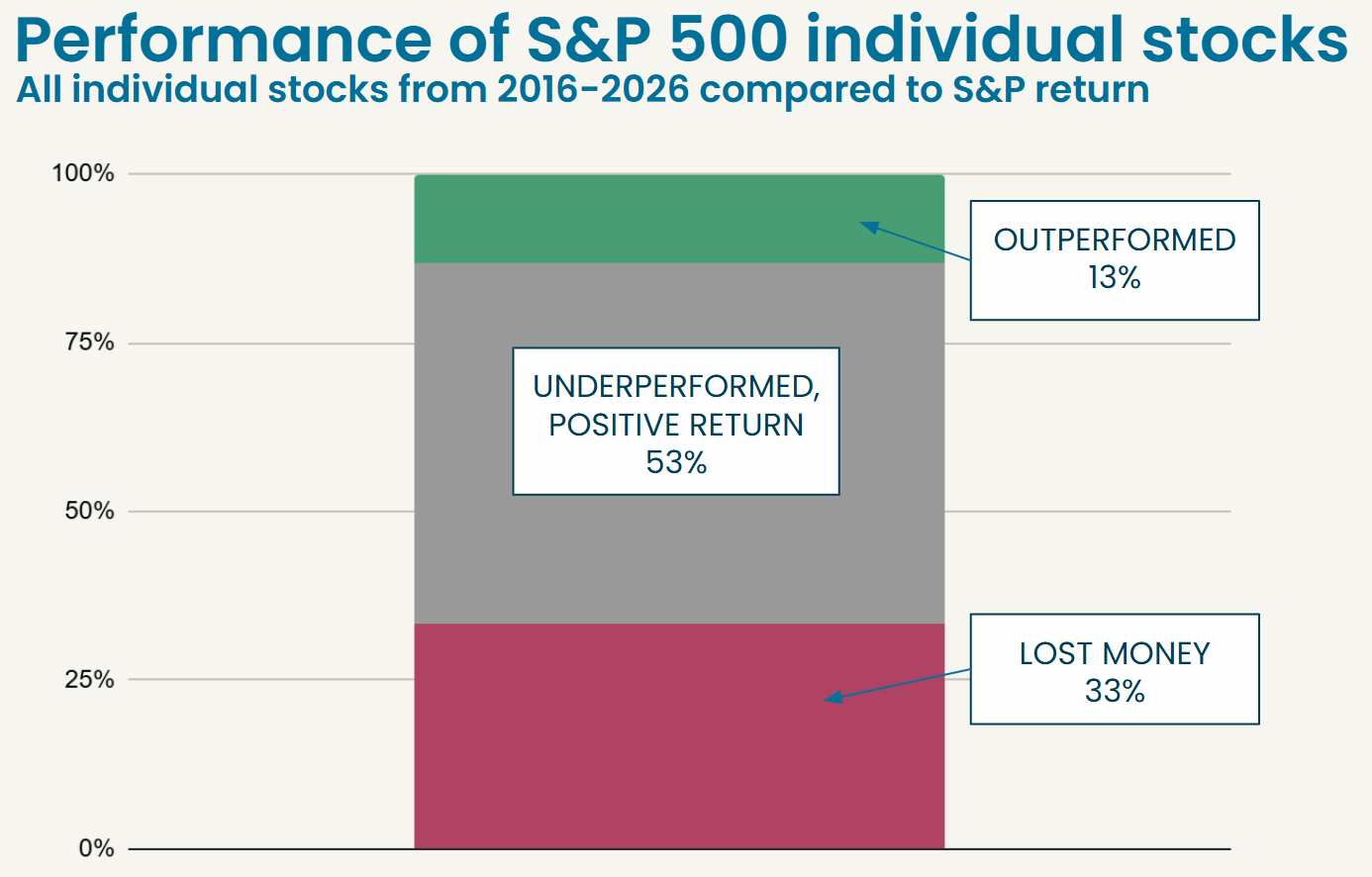
However, we believe successfully picking stock market winners is exceedingly difficult. Facet analyzed every company that was in the S&P 500 from 2016 to 2026 (including those that left the index). Only 13% of companies performed better than the whole index. Worse, 33% of stocks lost money outright. This suggests you had more than double the chance of picking a stock that lost money as you did a stock that did better than the whole S&P.
Source: S&P Dow Jones Indices
With only 13% of S&P 500 stocks beating the index, we think the odds are stacked against anyone picking stock market winners year after year. Hence why we think if you want to maximize the chance you achieve your financial goals, trying to pick individual stock winners is problematic. Your range of outcomes is probably quite wide. We think a diversified portfolio could narrow the range of outcomes, and if that’s true, it could also improve your chances of reaching your financial goals.
A big drop is a signal to reassess, not to panic or to wait for a rebound. Make the decision about the future, and about your plan, not about the old high.