

Over the last few months, AI-related stocks have been particularly volatile, reviving worries that there could be an AI bubble about to burst. On one hand, the AI buildout is arguably the biggest capital expenditure boom in history. If that continues, it could continue to power strong stock market returns, especially for the companies most benefitting from this investment spending. However, we also see a number of risks for AI stocks currently:
- Growing reliance on debt: Use of leverage can exacerbate losses, and a complex network of loan guarantees could shift costs from one company to another.
- Questionable return on investment: Building and equipping a datacenter requires a lot of up-front cost, and big tech companies have yet to show a large return on that investment.
- Competition from cheaper AI models: The most cutting edge AI models are extremely expensive to run, both for the AI labs creating the model and for companies accessing models. Companies could shift to cheaper models, which could disrupt the current AI ecosystem.
- Sustainability of profit margins: Shortages in various kinds of semiconductors needed for AI’s intense calculations have resulted in huge price increases for things like memory and processing units. This has allowed companies selling this equipment to earn huge margins that might not last if the shortages subside.
Facet has built our portfolios with both AI’s potential but also these risks in mind. In our view, each of these risks could create a distinct outcome for investors, with different kinds of stocks impacted. Therefore creating a balance of risks and opportunities requires a careful analysis of each of these scenarios. Here are some thoughts about each of these risks and how they might play out for investors.
The bull case for AI stocks
The bull case for AI stocks centers on the massive, multi-year buildout of AI infrastructure and the early stages of enterprise adoption. Valuations for top tech companies remain reasonable relative to their earnings, and sustained corporate spending on AI could continue to drive long-term profit growth.
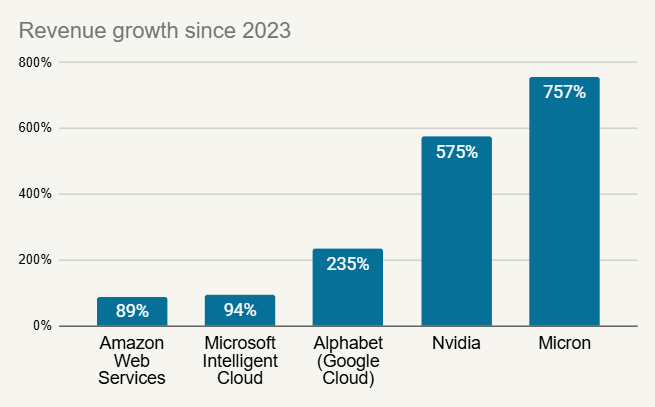
The chart below shows just how massive the AI boom has been for some of tech’s biggest companies. Here we look at revenue growth for cloud computing units for Microsoft, Amazon and Alphabet (parent of Google), as well as more AI-centric companies like Nvidia and Micron. We used the last three years, since that roughly coincides with when OpenAI released ChapGPT.
Source: Bloomberg
This pace of growth may not continue into the future, but it is unlikely that AI spending is suddenly going to go away. In fact, it is probably true that AI adoption by traditional businesses is still in the early innings. A recent McKinsey report suggested that 92% of companies are planning on expanding AI spending in the next three years, and only 1% believe their current AI use is “mature.” A report from AI software maker Azumo found that while 87% of large companies are using AI in some business functions, only 23% are actively scaling AI agents today.
In addition to likely continued AI spending, there are a few other simple reasons why AI stocks could keep rising:
- Valuations aren’t especially high: Most bubbles are characterized by irrationally high prices for stocks relative to actual company profits. That is mostly not true in U.S. public markets. Nvidia and Amazon have a P/E ratio lower that of the broad S&P 500. Alphabet has a P/E ratio equal to where it ended 2023. Microsoft has a lower P/E than Walmart. Micron, and Sandisk, two of the best performing AI stocks in 2026, have the second and third lowest P/E in the whole S&P 500.
- Markets expect AI growth to slow: The main reason why these P/E ratios are relatively low is that investors know these companies can’t keep up this kind of revenue growth forever. For example, according to Bloomberg’s survey of Wall Street analysts, Nvidia’s revenue has grown over 100% the last two years, but is expected to slow to 90% this year and 70% the year after.
- The AI correction may have already happened: As of November 4, 2026, the semiconductor index was already down nearly 30% from its June highs. It may be that the markets have already adjusted to some of the risks outlined above.
- The winners of AI might shift, but the broad market may perform well: If you are invested in a broadly diversified portfolio of stocks, you don’t have to pick any particular winners in the AI race. It might be that some stocks, like the semiconductors we just mentioned, could struggle while others boom.
How rising data center debt impacts AI companies
AI data center construction is heavily financed by debt, and the rising cost to borrow could pressure profit margins across the industry. Higher interest rates and increasing credit insurance costs may reduce profitability for large tech companies while threatening the survival of smaller, highly leveraged data center operators.
At its core, a data center is basically a real estate project. Like most construction projects, they are generally financed with a mix of equity from the project’s owner and loans. According to Goldman Sachs, approximately $500 billion in AI-related debt has been issued in 2026, overwhelmingly to fund data centers.
In recent weeks, the cost of this debt has been rising. This is partly just because Treasury bond yields have been rising. Rising Treasury bond yields impact almost all forms of borrowing, AI debt included. However, it is also because the perceived credit risk of some of these projects have also been rising.
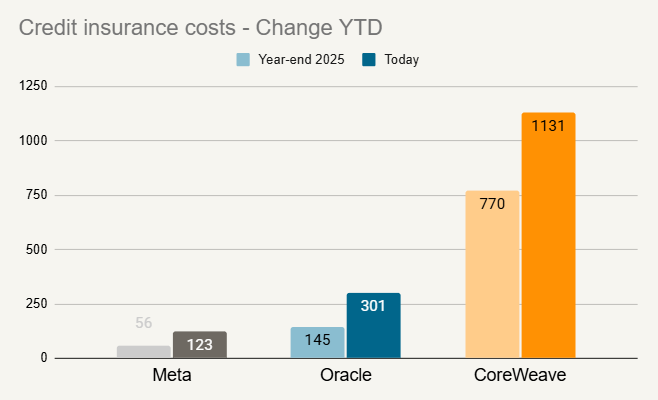
The chart below shows the cost of a credit default swap, a kind of insurance policy against a company defaulting, for three big AI companies. This insurance is quoted in 100s of a percent, meaning to protect $1 million from Meta going bankrupt costs 1.23% or $12,300. The higher this cost is, the more concerned Wall Street is about the credit risk of a given company.
Source: Bloomberg
We can see that all three companies have seen significant increases in the cost to insure their debt. However, this chart also shows that there are three very different problems caused by increasing debt levels among tech companies.
For Meta, the worry isn’t that the company will actually go bankrupt. The 1.23% cost to insure their debt is about the same as AT&T. The worry with Meta is the cost of new debt. Meta’s debt load has increased from $29 billion two years ago to $81 billion today. Meta has also guaranteed about $68 billion in data center debt that is technically owed by others, but Meta has agreed to backstop. This increase in Meta’s credit costs means any new debt will carry a higher interest rate. Building a state-of-the-art data center is already extremely expensive. Now the financing costs are adding to that expense. That could put pressure on Meta’s profits, which in turn could put pressure on the stock price.
CoreWeave is a stand-alone data center operator, referred to as a neocloud company. They have no other source of cash flow to support the huge cost of data center construction, and therefore have had to rely much more heavily on borrowed money. Credit insurance over 11%, as CoreWeave currently faces, implies that CoreWeave is at serious risk of bankruptcy. If that were to happen, it could shut off the debt markets to other neoclouds, effectively bringing a small but meaningful amount of data center construction to a halt. Today neoclouds represent about 11% of total data center demand.
Oracle’s perceived credit risk stands somewhere in between. At about 3%, Oracle’s credit default cost is similar to mid-range junk bond companies. This has forced the company to rethink its expansion plans. In late October, Oracle said they would limit new data center fundraising to $20 billion over the next three years. Then a few days later, the company decided to do all that financing up-front, launching a $20 billion debt and equity sale. The stock plunged almost 9%.
There is a risk of smaller, heavily leveraged companies like CoreWeave going under. There is also a risk of companies like Oracle finding themselves unable to keep competing for new data center projects given their cost of financing. Both of those scenarios create risks for their shareholders, and is a major reason why Facet is underweight smaller and more indebted companies.
For stronger companies like Meta, the story is more nuanced. Meta’s stock is down 8% year-to-date through November 4. In fact, all of the biggest hyperscalers (Meta, Alphabet, Microsoft and Amazon) have underperformed the S&P 500 year-to-date. The increasing cost, and questionable return on investment, of data centers is the main reason for this poor performance. At some point, something has to give. CEOs aren’t in the business of making their stock go down. Either the AI investment needs to start showing bigger profits or these stocks are at risk to keep languishing.
Will AI data center investments be profitable?
It remains uncertain if massive AI data center investments will deliver adequate returns in the near term. While companies are accelerating AI spending to protect their core businesses, Wall Street is increasingly concerned about high capital costs and the delayed profitability of these infrastructure projects.
As we said above, the biggest builders of data centers have seen poor stock performance so far this year. This has been driven by ever increasing costs, paired with a murky outlook for how profitable these data centers will turn out to be.
The CEOs of these companies face some tough decisions. On one hand, Wall Street keeps punishing their stocks every time they announce higher future AI spending. On the other hand, companies don’t want to fall behind as the world shifts to more AI usage.
Alphabet’s (parent of Google) recent earnings report is a perfect illustration of this challenge. Alphabet stock dropped 12% after it announced earnings in October. The company said that AI spending in 2027 would be “significantly” higher than 2026, but also indicated that AI might be making Google’s core search business less profitable. There is a risk that as more people use AI instead of a Google search, Google’s advertising business could suffer.
Should the company slow down AI spending? Or do they need to keep spending to transform their ad business ready for the AI world? The answer is probably the later, and that is probably why Alphabet is planning to accelerate spending in 2027.
This may wind up with Alphabet simply being a worse business than it used to be. By this we mean, pre-AI, Google’s search business was highly profitable and required relatively low capital investment. It produced huge free cash flow that could be used for stock buy-backs or for reinvestment into new lines of business, such as Android. AI requires huge computing costs, expensive retraining of models, construction and maintenance of data centers, etc. Even if Alphabet can catch up in the AI race and maintain their powerful ad search business, it may just be a more expensive, less profitable business going forward.
In this world, we might see a rotation of stock market winners. Big spending by companies like Alphabet will fuel profits for other players in AI, such as memory or graphics chips, while the big spenders struggle. We saw a bit of this in 2Q 2026. Remember, there is no guarantee that yesterday’s winners will remain winners into the future.
How would restrictions on data center construction impact AI stocks?
State and local government restrictions on data center construction could push facilities into less ideal locations, likely raising operational costs. While not an existential threat to the AI industry, these regulations could make it more difficult for AI companies to realize an adequate return on their infrastructure investments.
Data centers are extremely unpopular, and politicians have been paying attention. Already there are a large number of restrictions or moratoriums on new construction, and this is a trend that could continue. Our view is that data centers will still get constructed, but the restrictions could result in less ideal locations, likely pushing up the cost to operate those data centers.
In other words, political pressure on data centers probably isn’t an existential threat to AI spending, but could make it all the more difficult for AI companies to realize adequate return on their data center investment.
How open-weight AI models compete with frontier models
Open-weight AI models provide a cheaper alternative for businesses compared to highly expensive frontier models. If corporate usage shifts toward these lower-cost open-weight models, frontier AI labs could see reduced revenues, which may force them to slow their training pace and alter data center demand.
When most people type something into an AI chatbot, we don’t experience any cost. But when companies employ AI at large scale, they are paying for that use in the form of tokens. The cost of a given AI process depends on a variety of factors, but one of those factors is simply which model you choose to use. The most powerful models from the cutting edge labs, like Anthropic’s Fable or OpenAI’s Astra, are a lot more expensive than open weight models. These include Meta’s Llama, Mistral, or several Chinese models.
These models might not be quite as powerful as the frontier models, but for a lot of business purposes, they probably are good enough. Traditional businesses are probably going to get a lot of value from having AI do relatively narrow, repeated tasks. That doesn’t require the most cutting edge, high cost model.
Unfortunately for the frontier AI companies, they have spent a lot of money developing and training those cutting edge models. For companies like Anthropic or OpenAI to get a return on that investment, they need a certain usage rate. If usage shifts toward lower cost models, it could be painful for these companies.
They might respond by slowing down the pace of training. Perhaps they will still be building new frontier AI models, but do so at a slower pace. In our article about AI safety we mentioned how slower training could shift winners and losers in the stock market. For example, it could be negative for Nvidia, who has made huge profits selling the absolute top-of-the-line processors.
It could also shift data center demand, especially from the frontier labs themselves. Anthropic recently filed their financials in preparation for an initial public offering, likely sometime in November. In that document, it was revealed that some of the company’s data center leases are long-term in nature and cannot be broken without triggering a default. This includes leases of Amazon, Microsoft and Google data center capacity. However, other lease agreements can be canceled with just 90 days notice, including a $120 billion lease with SpaceX.
So there is a scenario where the kind of data center demand shifts, which causes a shift in how much capacity Anthropic and others need. This might not matter much for Microsoft, but might matter quite a bit to SpaceX.
Worth noting that a world where cost to access AI models falls might not be great for some AI companies, but could be very good for the rest of the stock market. In this scenario, the value from AI’s capabilities could accrue disproportionately to the user of AI, not the seller of AI. It also could be that cheaper per-token AI usage actually causes an increase in total AI demand. I.e., each token becomes more useful at a lower cost, causing companies to use more of them. That outcome could be bullish for a lot of AI stocks.
Are AI hardware profit margins sustainable?
Current profit margins for AI hardware makers may not be sustainable over the long term. While equipment manufacturers currently enjoy record margins due to component shortages, technological shifts or a cooling in demand could ease these shortages and put downward pressure on stock prices.
AI has created an explosion of demand for a variety of components: from graphic processors to memory to storage. For companies like Nvidia, they dominate the high-end of AI processors. If you want to train a world-class AI model, you probably need a bevy of cutting-edge Nvidia chips to do it. Because of the competition among AI labs and cloud computing providers, Nvidia can charge astronomical prices for these chips.
Companies like Micron or SK Hynix that make high-bandwidth memory chips are selling their products faster than they can make them. Like Nvidia, this is allowing them to raise prices on memory to record levels. Historically the memory business has been extremely boom-bust, with periods of high demand being followed by periods of oversupply and plunging prices. This has resulted in memory producers being slow to increase production, but are now starting to ramp up.
Say that demand for compute slows for some reason. Maybe it is related to companies shifting to lower intensity open-weight models. Maybe it is related to the big AI labs slowing the pace of training. Or it could just be some technological improvement change. Google and others have been working on their own processor design, which could eat into demand for Nvidia chips. Others have been working on types of memory that are specifically designed for AI, which could alleviate the shortage in memory chips.
If this were to happen, companies like Nvidia or Micron wouldn’t be able to charge such astronomical prices for their products. That would put downward pressure on their profits and ultimately also their stock price.
It is almost inevitable that there will be technological shifts. There always are. Earlier we mentioned that the P/E ratio for Nvidia and Micron aren’t especially high. This is a primary reason why. Wall Street doesn’t think the huge profit margins these companies are enjoying will last forever. Regardless, it is important to remember that the world of tech is always in motion, and change could have a wide range of impacts on different players in the AI ecosystem.
What is the outlook for AI stocks?
Given the wide range of potential outcomes, the outlook for AI stocks may require a balanced, diversified approach. At Facet, we favor maintaining a neutral weight in the tech sector, overweighting highly profitable companies with low debt burdens while underweighting speculative, highly leveraged firms.
Hopefully you have read this article and came away a bit uncertain. We have outlined a range of risks and opportunities, all of which we think are plausible. However, we don’t know, and I think no one knows, exactly which of these scenarios might come to fruition.
At Facet we think this is the power of scenario-based investing. We prefer to look across the whole gamut of possibilities, and try to invest in such a way that we could perform reasonably well across all of them. Right now that means being roughly neutral weight tech overall. Within tech, we are overweight tech companies with certain characteristics:
- Lower debt burdens: This increases financial flexibility and reduces exposure to rising debt costs.
- Highly profitable: We are especially underweight unprofitable companies, which rely on debt or equity financing to continue to survive.
- Low revenue volatility: These are the kinds of companies that could be more resilient in any slowdown of AI demand.
- Larger vs. smaller companies: We are modestly underweight smaller companies, which tend to be less diverse businesses.
Conversely we are underweight companies with the opposite traits, which I would collectively call more “speculative.” We think that if AI spending continues apace, companies with this profile could keep up with the market. However, if there were to be some kind of faltering in AI, the more speculative companies could be the more vulnerable.
Admittedly, this approach forgoes the opportunity to make the perfect trade. Guessing which companies are going to be the AI winners, or trying to time some kind of AI downturn, are both extremely difficult. If you make those bets and get them wrong, you could really impair your portfolio’s ability to reach your goals. We prefer to focus on a mix of offense and defense within portfolios, all meant to maximize the chance you achieve your financial outcomes.