

Market volatility can create anxiety among even the most seasoned investors. A lot is going on and it has all of us asking questions about our investments. Should you worry? Should you make a change? Here’s what you need to know.
“The stock market is a device to transfer money from the impatient to the patient.”
-Warren Buffett
When market volatility strikes, it can be quite unsettling to even the most seasoned investors. Whether it’s interest rates, inflation, uncertainty over the global pandemic and the impact on the economy, or something else, it can all have a profound impact on day-to-day market fluctuations.
But is there a reason for concern? Is this time different from the past periods of uncertainty? And should you do anything differently? The truth is that we have been here before and this certainly won’t be the last time. Here’s what you need to know about market volatility and how to navigate the ups and downs with greater clarity and confidence.
Recent market volatility explained
We ended 2021 with inflation at 7% on a year-over-year basis which is a 40-year high. Concerns over inflation are nudging policymakers in D.C. to raise interest rates. Higher inflation can increase costs and reduce earnings for companies, and higher rates mean future revenue is valued less in current dollars (i.e. less cash flow equals lower stock prices). With continued concerns over COVID-19, supply chains that are out of whack, and worry of higher inflation and interest rates, the market can get a little spooked.
Add to this a stock market that some are calling “overvalued” and people start asking, “Is it time for a correction?” The interesting thing about investors is that no matter the conditions in which we find ourselves, we will always find something to worry about.
There’s always something to worry about
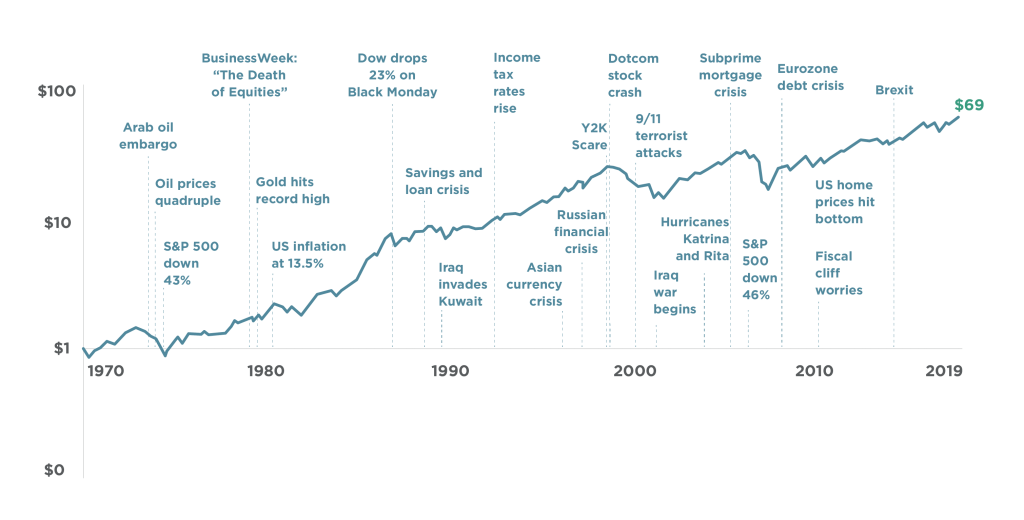
There’s a saying on Wall Street that “stocks climb a wall of worry.” When stocks are doing well, investors are always looking for reasons for the party to end. When will the next correction hit? How long will this run last? And when the markets post a few days of negative returns, investors quickly start thinking about the worst – the next downturn, correction, or even recession. The truth is that there is always something to worry about, but stock and bond markets remain resilient if you have patience and are willing to stay the course.
In the example below, $1 invested in 1970 would be worth almost $70 today if, and it’s a big if, you remained fully invested over that period of time. That’s almost a 9% compounding rate of return on an annual basis. As you will see below, not all investors get this return because of how they react to volatility.
Market volatility is a normal part of investing
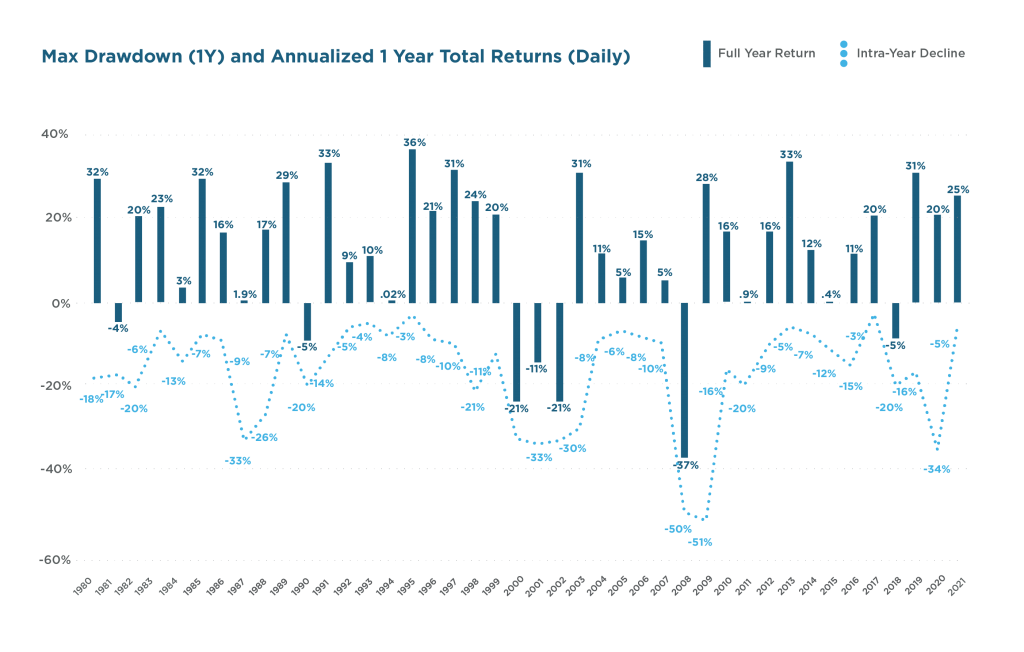
Here is a timeless principle of investing: to achieve a higher return you need to take on more risk. That risk is often seen in the price fluctuations, or volatility, that a stock or more diversified investment, like an exchange-traded fund (ETF), may exhibit. As you can see from the chart below, the market often experiences rather large swings, and often losses, during the year. In most cases, the market still ends up posting a positive return.
Market declines of 10% or more during the year are quite common. In the last six years alone, we have seen four years with intra-year losses of more than 15%. And despite the ups and downs, the Russell 3000 rewarded disciplined investors with an average annual return of over 9% since 1980. The goal isn’t to time the market, it’s to invest and participate in it.
 Russell 3000 Index returns from 1980 through January of 2022.
Source: Facet Wealth Analysis, Ycharts, Russell 3000 Total Return
Timing the market doesn’t work
The strategy seems to make sense: if we can get all of the gains and avoid all of the losses we will end up in much better shape. The problem is that this is nearly an impossible task. Even professional investment managers (who try to beat the market through stock selection and market timing) can’t do it. In fact, 80% to 90% or more of actively managed investments underperform the market.
If we look at individual investors and their track record, the average equity (stock) investor trailed the S&P 500 over a 30 year period by more than 4% per year as of December 31 of 2020*. Missing a 4% compounding return over decades can be devastating to your wealth. Why does it happen? The average investor thinks that they will sell before the downturn and then buy when things are better. But reasons to worry and volatility always persist so they end up selling and getting back in at the wrong times.
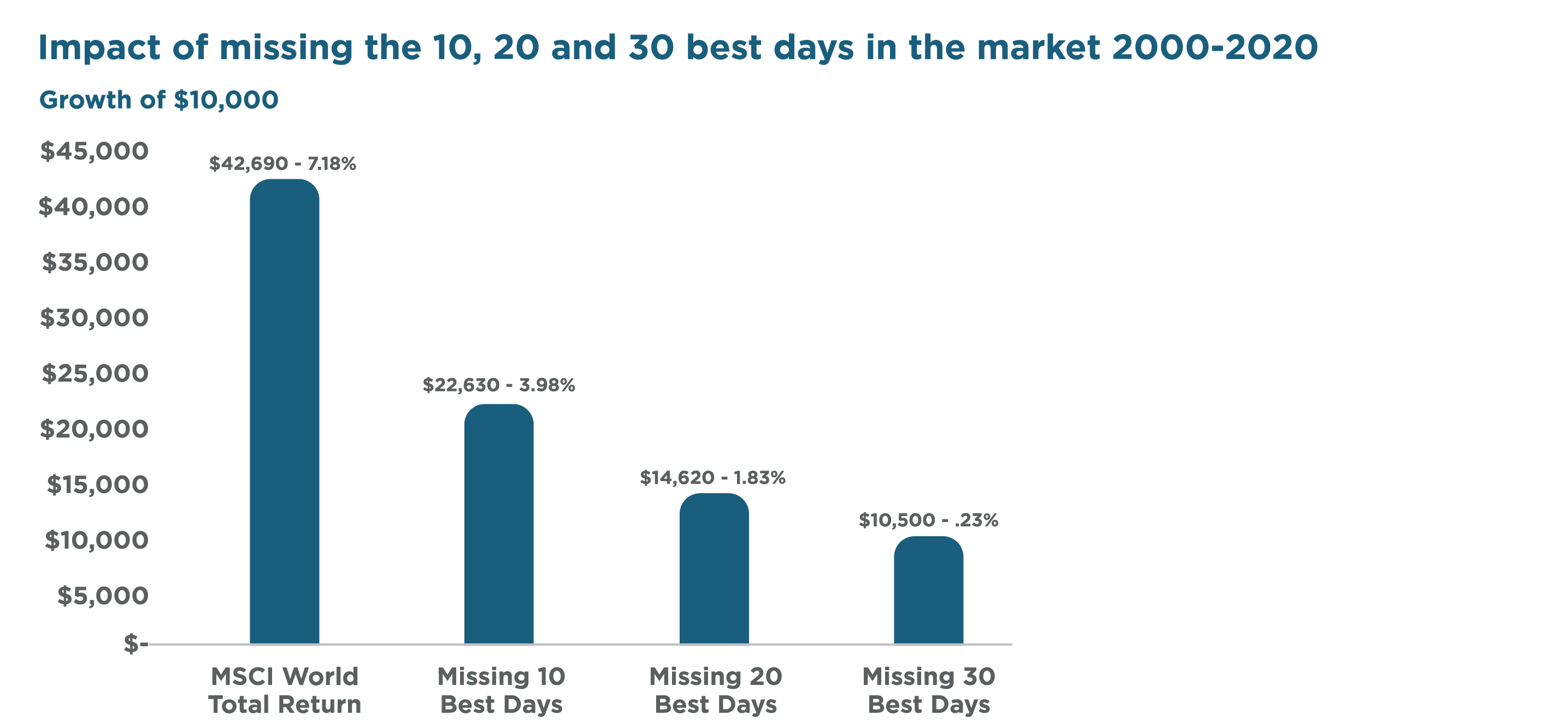
Missing only a few days of returns can dramatically affect your investment outcomes. For example, from 2000 to the end of 2020, a $10,000 untouched investment would have grown to almost $43,000. Missing only the 10 best days out of almost 5,000 trading days would have cut your potential growth by more than half, and your investment would only be worth about $23,000.
 Facet Wealth Analysis, YCharts, MSCI World Total Return.
Source: Facet Wealth Analysis, YCharts, MSCI World Total Return
Market timing sounds like a reasonable strategy, but it never works consistently to your advantage over time. Professional and individual investors alike only hurt their long-term performance when they try.
Adjust your risk to manage your volatility
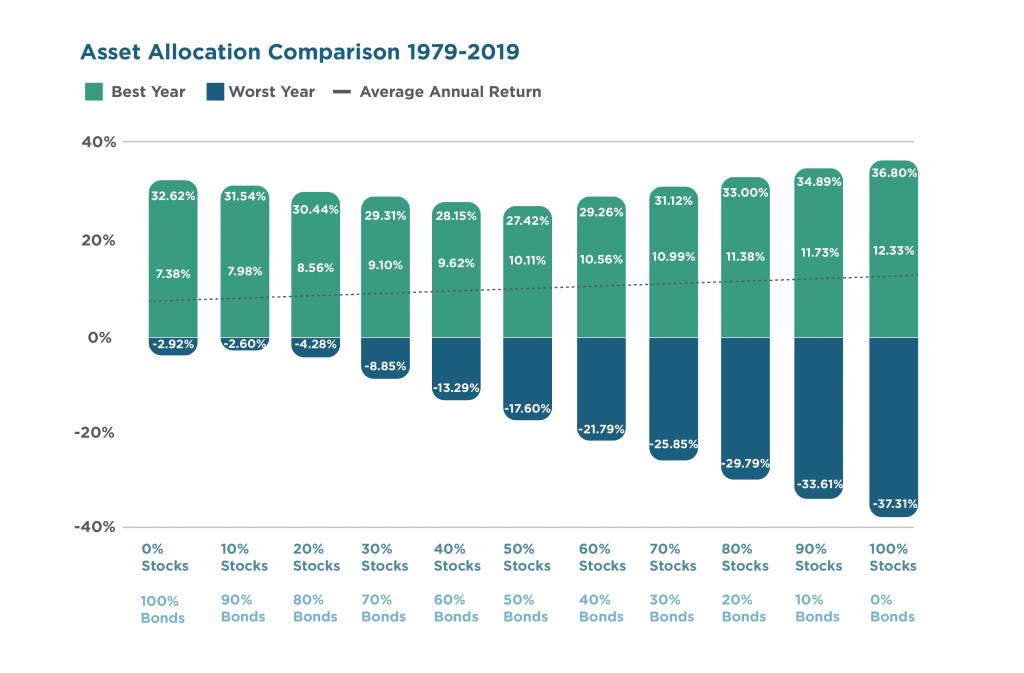
The goal of investing is not to achieve the highest rate of return possible. It’s to achieve an appropriate level of return with the right amount of risk that will allow you to stay invested through good times and bad. The level of risk that is right for your strategy, and the volatility that you can handle, is a very personal matter. This is one reason why people approaching or in retirement invest differently and have a higher allocation to bonds. They want more stability and less risk while still having some exposure to stocks for long-term growth.
If volatility is unsettling for your situation, keep in mind that you can make adjustments to how much risk you take. It’s not an all-or-nothing decision. As the chart below shows, investing isn’t the same for everyone. You need a personalized strategy to find the right mix of stocks and bonds that will help you stay the course.
 Average Annual Returns and Range of Returns for Different Asset Allocations
Source: Facet Wealth Analysis, YCharts, Stocks - Russell 3000, Bonds - Bloomberg US Agg Total Return Value Unhedged USD Index
Bonds get a bad rap from time to time, but they are an essential part of minimizing risk in your investment strategy. Stocks are your gas pedal and bonds are your brakes. You need them both to make it safely to your destination.
Focus on what you can control
“The best way to measure your investing success is not by whether you’re beating the market but by whether you’ve put in place a financial plan and a behavioral discipline that are likely to get you where you want to go.”
-Benjamin Graham
During times of turmoil, the hardest thing to do is to stay the course, but this approach is critical to achieving long-term investment outcomes. The key is to focus on what you can control. You can’t control interest rates, inflation, the markets, changes in tax policy, or the economy. But a dynamically evolving financial plan puts you in control of what you can – how much you invest, where you invest it, the level of risk you take, your level of diversification, and how you minimize fees and taxes.
And staying the course doesn’t mean you aren’t making adjustments along the way. Market volatility can create opportunities through portfolio rebalancing, tax-loss harvesting, and even buying when stock valuations are low.
Remember, there will always be something to worry about. But in the end, an ongoing plan for your life and your money will matter far more than what markets do in any week or year. With the right strategy in place and with the flexibility to make adjustments along the way, you’ll put yourself in control of the decisions you make and navigate today and tomorrow with greater clarity and confidence.
*Average Investor as determined by Dalbar. Source: "Quantitative Analysis of Investor Behavior (QAIB), 2021," DALBAR, Inc.