For those looking to buy a new house, the last few years have been extremely frustrating. Home prices have just kept rising across most of the U.S., while mortgage rates have stayed stubbornly high. This combination has resulted in housing affordability well below anytime between 2007 and 2022. According to a recent CNBC survey, housing affordability is the #1 political issue among voters 18-34 years olds. For those looking to become homeowners, is there any hope on the horizon? Unfortunately, today’s housing crisis was decades in the making, and it may take just as long (if not longer) to resolve. That being said, there are some short-term paths to housing becoming more affordable. Here are our thoughts on where housing prices and mortgage rates may be headed, and how that could impact your decisions about buying a home.
Why are home prices so high?
There are three key reasons why home prices are so high currently: demand is strong due to demographics, few existing home owners are selling, and new housing construction has been slow in recent years.
As any economics text book will tell you, the price of anything is a function of supply and demand. In the case of the U.S. housing market, demand is strong, and supply is tight. That’s a clear recipe for prices to rise. Specifically there are three factors causing supply and demand to push prices higher:
- Strong demographic demand: The Millennial generation is the largest demographic group, and they are hitting their prime home buying years.
- The mortgage lock-in effect: Few existing homeowners are selling, in large part because they hold mortgages far below today’s rates.
- Slow new housing construction: Builders haven't kept pace with the growth in demand over the last two decades.
Let’s unpack each of these factors.
The Millennial Generation, typically defined as those born between 1981 and 1996, are currently in prime home buying age ranges. Moreover, the Millennial Generation is currently the largest in the U.S. This is fueling strong demand, especially for single-family homes.
Meanwhile, there aren’t a lot of homes for sale, at least not relative to demand. This is partly due to the mortgage lock-in effect: which is the phenomenon where current homeowners have an existing mortgage loan that is far below today’s mortgage rate. The cost of getting a new mortgage is so exorbitant that these owners almost can’t sell. We can see this phenomenon in action by looking at existing home sales, which are currently near 2008 levels.
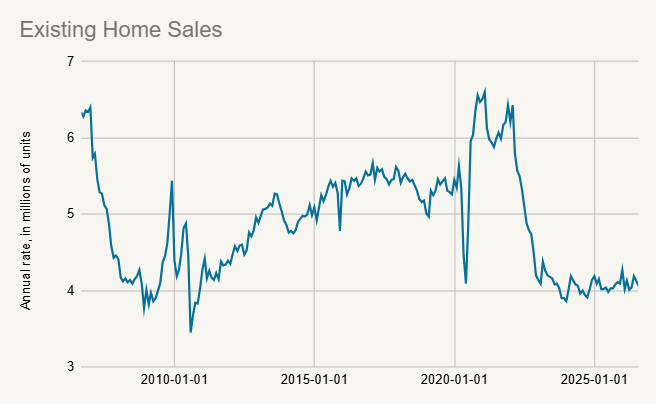
Source: National Association of Realtors
New construction also isn’t adding enough to the available supply of homes. So far in 2026, we are on pace to start construction on 906,000 new single-family homes. That would be the slowest pace since 2019. Perhaps more notably, 25 years ago, when Generation X was in their peak home buying years, we were building around 50% more homes per year than we are today. The Millenials are today a larger group by numbers, but new home construction hasn’t kept up.
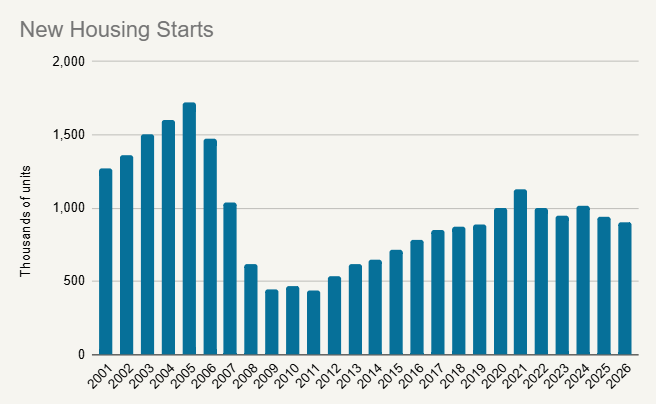
Source: Census Bureau
Will mortgage rates drop in 2026 or 2027?
Mortgage rates could decline modestly if inflation starts to subside. To get a large drop in mortgage rates, there probably needs to be a U.S. recession.
According to Freddie Mac, the national average mortgage rate is currently 6.65%, up from 6.00% at the start of March. This rate has been bouncing around between 6% and 7% since 2024, providing no real relief on home affordability, nor creating much opportunity for refinancings.
Unfortunately, nothing about current conditions suggest rates are likely to drop in a big way anytime soon. Inflation has been stubbornly high for the last five years, and new Federal Reserve Chair Kevin Warsh seems likely to hike the Fed’s target rate at least once later this year. Futures markets are priced like the Fed will hike about 1.5 times between now and the middle of 2027. That tells us that traders expect one hike for sure and then something like 50/50 odds of a second hike. This means that if the Fed is forced to hike more aggressively to combat inflation, general interest rates could rise further, including mortgage rates.
If a single rate hike does the trick and inflation starts to subside, there is definitely room for mortgage rates to drop. However, slower inflation alone probably only gets mortgage rates down into the 6.00% area. For rates to drop more significantly, we probably need the Fed to be cutting rates significantly. Unfortunately, that probably only occurs if the economy has slowed substantially, perhaps even in a recession.
How much lower rates would actually improve home affordability isn’t clear. Because there is so much pent up demand for homes, it may be that falling mortgage rates result in buyers bidding up home prices.
Could more home building help affordability?
In the longer term, more home construction is probably the best way to make housing more affordable. However, it will take time for the effects of more construction to be realized, and the impact on single-family housing affordability is unclear.
In recent years, the consensus has become that increasing the supply of homes is a necessary step toward improving home affordability. Note that the “21st Century Road to Housing Act” passed both houses of congress with broad support from both parties. Encouraging more housing construction, through incentives, financing and removing barriers, is at the center of this legislation. That we get both parties agreeing on anything shows just how broad the consensus around housing supply has become.
There are also many state and local programs aimed at encouraging more home supply. There are ambitious ideas like converting unused office space to apartments or rehabilitating vacant homes. There are also simpler ideas, like relaxing zoning restrictions, that could result in more housing units being constructed.
From an overall housing affordability perspective, these are very encouraging signs. However, that optimism comes with a few caveats:
- Construction takes time: Multi-family construction is on the rise. We are on pace to start construction on 452,000 new multi-family units in 2026, up 27% from 2024. However, large scale apartment projects can take multiple years to complete. It will take time for the effect of new construction to flow through to lower rents.
- Impact on single-family homes unclear: Most of these efforts are focused on apartment building. There is plenty of evidence that any kind of construction makes rental units more affordable across the income spectrum. However, it is not clear that cheaper rents will slow the pace of single-family home prices. It could be that lower rental rates start to discourage investors from buying homes to rent them out. Something like 18% of all single-family homes are owned to rent. If that percentage were to decline, it could put downward pressure on single-family home prices.
Is now a good time to buy a house?
Whether now is the time for you to buy a house depends mostly on what you can afford and your particular stage in life. Think of it less like an investment and more like a lifestyle choice.
For those hoping to buy a house, we didn’t provide a lot of good news in this article. The housing market is very expensive, both in terms of cost to borrow and the price of homes, and it isn’t obvious that either of these circumstances are about to improve.
That being said, waiting to buy a house might not be the right answer either. Given how strong demand is, home prices could keep rising. Moreover, if interest rates fall, there might be a rush to buy.
So should you buy a home? Here are some factors to consider:
- Check your emotions: Don’t get wrapped up in fear of missing out or frustration over rising prices. Buying a house is a huge financial decision. Make it an objective and well-thought out one.
- Assess your readiness: Make sure you are ready to be a home owner, not just a buyer. Buying a house is a big commitment. You’ll be dealing with all kinds of new costs as well as less flexibility. Understand how it will affect your finances and overall plan today and for years to come.
- Avoid thinking of your house as a traditional investment: Yes, it is true that home prices could easily keep going up, but they might not. We would argue that buying a home expecting price appreciation makes it more likely to make a mistake.
There’s no one-size-fits-all answer to all of these questions, but getting the plan right can make a huge financial difference to you. With all that said, if you're ready and you've planned to purchase a home, go for it and enjoy it!
This article is intended to be an analysis of current market news only. It is not intended to be advice, a recommendation or any type of forward guidance